


03 Feb Transforming India into a Global Biopharma Hub
This article covers “Daily Current Affairs” and From Transforming India into a Global Biopharma Hub
SYLLABUS MAPPING
GS- 3- Science and technology – Transforming India into a Global Biopharma Hub
FOR PRELIMS
What is meant by biopharma?
FOR MAINS
What is the target global market share India aims to achieve in biopharmaceuticals?
Why in the News?
The Union Budget 2026–27 signals a major reorientation of India’s pharmaceutical strategy by bringing biopharma and biologic medicines to the forefront of healthcare and manufacturing policy. This shift aligns with the Government of India’s long-term vision of positioning the country as a leading global biopharma player, with an ambition to secure 5% of the global biopharmaceutical market.
With non-communicable diseases steadily rising and biologics becoming central to modern medical treatment worldwide, the Budget recognises biopharma as a high-value, future-oriented sector that is vital for both public health outcomes and sustained economic growth.
Biopharma involves the development and production of therapeutic products using living biological systems such as human cells, microorganisms, fungi or microbes. These include vaccines, monoclonal antibodies, gene and cell therapies, recombinant proteins, modern insulin and other advanced biologic medicines.
Union Budget 2026–27: Biopharma SHAKTI Initiative
Key Budget Announcements for Biopharma
A central feature of the Budget is the launch of Biopharma SHAKTI, a national-level initiative with a total outlay of ₹10,000 crore over five years. The initiative is aimed at strengthening India’s entire biopharma value chain, particularly in the areas of biologics and biosimilars.
The programme seeks to:
Support domestic development and manufacturing of high-value biopharmaceutical products
Reduce dependence on imported biologics
Enhance India’s competitiveness within global biologics supply chains
To address the growing demand for specialised expertise, the Budget also announced the expansion of biopharma-focused education and research infrastructure. This includes the establishment of three new National Institutes of Pharmaceutical Education and Research (NIPERs) and the modernisation of seven existing NIPERs, with a focus on biopharma research, manufacturing, regulation and innovation.
Another major component is the creation of a nationwide clinical research ecosystem, with plans to develop more than 1,000 accredited clinical trial sites across the country. This is expected to significantly improve India’s ability to conduct advanced clinical trials for biologics and biosimilars, while strengthening its position as a global destination for ethical, efficient and high-quality clinical research.
The Budget also places emphasis on regulatory strengthening, particularly for complex biologic products. The capacity of the Central Drugs Standard Control Organisation (CDSCO) will be enhanced through the induction of specialised scientific and technical personnel, with the objective of improving regulatory efficiency, aligning approval timelines with global benchmarks and enabling faster evaluation of advanced biopharmaceutical products.
Why This Matters
The Budget integrates manufacturing capacity, skilled manpower, clinical research infrastructure and regulatory credibility into a unified policy framework. This reflects a clear intent to move India up the pharmaceutical value chain, transitioning from a cost-driven producer of generic medicines to a global hub for innovation-led, high-quality biopharmaceuticals.
By strengthening domestic capabilities in biologics and biosimilars, the Budget also lays the foundation for India to compete more effectively in the global biopharma market, while ensuring improved access to advanced and affordable biologic therapies for its population.
Understanding Biopharma
In recent years, pharmaceutical innovation has increasingly shifted away from conventional chemical drugs towards therapies derived from biological processes. This transition has brought biopharma to the centre of modern healthcare.
Biopharmaceuticals are medicines that are developed and manufactured using living biological materials, rather than relying solely on chemical synthesis. These may involve human or animal cells, bacteria, fungi or other biological platforms that are engineered to produce therapeutic substances.
Through biotechnology-based research and production methods, these living systems are guided to generate medicines that can prevent, diagnose or treat diseases. Because they are biologically derived, biopharma products tend to be more complex and precisely targeted than traditional drugs, allowing for more effective intervention in specific disease pathways.
Vaccines, therapeutic proteins, biosimilars and other advanced biologics have become indispensable to public health programmes and clinical care, particularly for infectious diseases, chronic illnesses and conditions where chemical drugs have limited effectiveness. Government-led policy support has played a crucial role in nurturing this evolving biopharma ecosystem and strengthening India’s aspiration to emerge as a globally competitive biopharma hub.
NBM as a Driver of Health Innovation
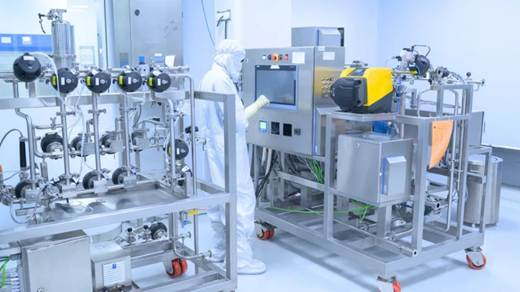
One of the most significant outcomes of the National Biopharma Mission has been the emergence of a new generation of biotech entrepreneurs translating scientific research into affordable healthcare solutions.
For instance, a Bengaluru-based start-up developed India’s first indigenously manufactured MRI scanners comparable to global standards, but at a significantly lower cost. These energy-efficient machines are already being deployed in cancer hospitals, improving access to advanced diagnostics. Similarly, a Chennai-based company developed India’s first biosimilar of Liraglutide for Type 2 diabetes at nearly one-third the cost of imported alternatives, with substantial clinical trial support from the mission.
NBM-backed ventures have also contributed to the development of antibiotics and vaccines for diseases such as dengue, malaria, pneumonia, chikungunya and Hepatitis E, and supported the development of the world’s first DNA-based COVID-19 vaccine.
The mission has funded early-stage innovation across thousands of bio-based start-ups, supported extensive incubation infrastructure, facilitated intellectual property creation and enabled large-scale clinical trials through a national volunteer database.
BIRAC-led Biotech Innovation Support
Established in 2012 under the Department of Biotechnology, BIRAC plays a central role in India’s biotech innovation ecosystem. It supports innovation through targeted funding schemes, incubation infrastructure and mentorship, with 95 bio-incubation centres across the country.
Key support mechanisms include early-stage innovation grants, proof-of-concept funding, commercialisation support and sector-specific challenges focused on digital health and emerging technologies. These programmes are aligned with national biotechnology and innovation priorities and focus on addressing India’s healthcare and development needs.
Manufacturing and Industrial Strengthening Measures
To strengthen domestic pharmaceutical and biopharma manufacturing, the government has introduced several industrial support schemes, including:
1.Production Linked Incentive (PLI) Scheme for Pharmaceuticals
2.Strengthening of Pharmaceutical Industry (SPI) Scheme
3.Bulk Drug Parks Scheme
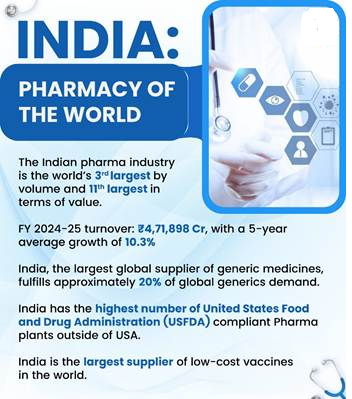
These initiatives aim to enhance manufacturing capacity, reduce dependence on imported active pharmaceutical ingredients (APIs), upgrade MSMEs to global manufacturing standards and develop common infrastructure within pharmaceutical clusters. Collectively, they contribute to improved supply chain resilience, quality assurance and export competitiveness.
Promotion of Research and Innovation in Pharma-MedTech (PRIP)
Launched in 2023 with an outlay of ₹5,000 crore, the PRIP scheme seeks to transform India into an innovation-driven and globally competitive Pharma-Med-Tech sector. It supports both early- and late-stage research in new drugs, biosimilars, complex generics, precision medicine and advanced medical devices, while promoting collaboration between industry and academia through Centres of Excellence at NIPERs.
BioE3 Policy and Bio-RIDE Scheme
The BioE3 (Biotechnology for Economy, Environment and Employment) Policy, approved in August 2024, aims to promote sustainable biomanufacturing, bio-AI hubs and biofoundries to support a Viksit Bharat. It focuses on innovation-driven solutions for healthcare, climate change, food security and employment generation.
Complementing this, the Bio-RIDE scheme, launched in September 2024, integrates biotechnology research, entrepreneurship development and biomanufacturing under a single framework. With an outlay of ₹9,197 crore, the scheme supports cutting-edge research, industry–academia collaboration, sustainable biomanufacturing and capacity building for students and young researchers.
Conclusion
Together, these initiatives reflect a coordinated and long-term policy strategy to build a resilient and innovation-driven biopharma ecosystem in India, encompassing research, manufacturing, entrepreneurship and regulation. This alignment is particularly critical as India’s disease burden increasingly shifts towards chronic and non-communicable conditions that require biologic therapies.
The Biopharma SHAKTI initiative, announced in the Union Budget 2026–27, stands out as a pivotal intervention in this journey. With sustained investments in workforce development, nationwide clinical research infrastructure and regulatory strengthening, the scheme reinforces India’s ambition to emerge as a globally competitive biopharma manufacturing and innovation hub, while ensuring wider access to advanced and affordable biologic medicines.
Best ias coaching in delhi Best ias coaching in chandigarh
Prelims question:
Q. Which of the following are examples of biopharmaceutical products?
1. Vaccines
2. Monoclonal antibodies
3. Recombinant insulin
4. Traditional painkillers
Select the correct answer using the code below:
a) 1 and 4 only
b) 1, 2 and 3 only
c) 2 and 3 only
d) 1, 2, 3 and 4
Answer: B
Q. Examine the role of the National Biopharma Mission (NBM) in strengthening India’s biotechnology and healthcare innovation ecosystem (250 words)

- Artemis II: Humanity’s Return to Lunar Space and India’s Place in the New Moon Race - April 2, 2026
- A Missed Opportunity to Guarantee Minimum Wages - March 31, 2026
- ‘India’s Growth Claims, A Clash with Data Reality’. - March 30, 2026

No Comments