


26 Feb Unlocking India’s Potential: The Rise of Industrial Corridors
This article covers “Daily Current Affairs” and From Unlocking India’s Potential: The Rise of Industrial Corridors
SYLLABUS MAPPING
GS- 3- Industrial Corridors in India – Drivers of Economic Transformation – Unlocking India’s Potential: The Rise of Industrial Corridors
FOR PRELIMS
What is the National Industrial Corridor Development Programme (NICDP)?
FOR MAINS
Discuss the economic significance of industrial corridors in India.
Why in the News?
India is aggressively pursuing an infrastructure-led growth model designed to facilitate a structural transformation of the economy. At the heart of this strategy are industrial corridors, which serve as growth multipliers by integrating manufacturing hubs with high-speed transport networks. Guided by the PM Gati Shakti framework, the National Industrial Corridor Development Programme (NICDP) aims to create a network of future-ready hubs equipped with logistics efficiency and plug-and-play infrastructure. This initiative directly supports the Make in India vision by lowering production costs and strengthening global market access. While not explicitly mentioned in the sources, industry standards often cite India’s logistics cost at approximately 13–14% of GDP, a figure the government seeks to reduce through these coordinated multimodal linkages.
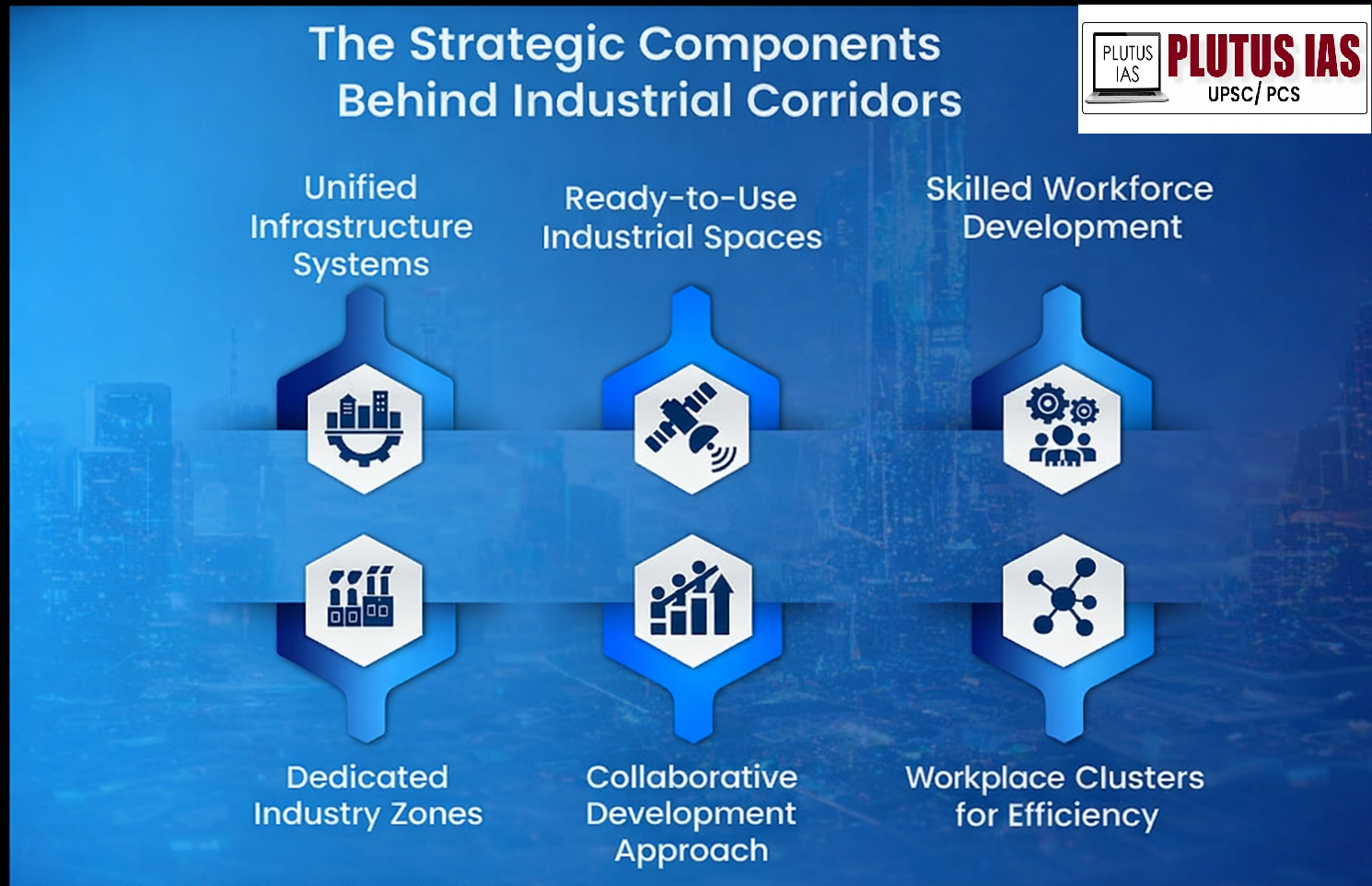
Concept of Industrial Corridors
Industrial corridors are defined as linear development zones that connect major economic centres through an integrated infrastructure region of roads, railways, ports, and airports. These corridors are not merely transport routes but urban-industrial ecosystems that facilitate manufacturing clusters and industrial clustering. Key features include multi-modal connectivity and the development of smart cities alongside industrial nodes. A hallmark of this model is the plug-and-play infrastructure, which provides ready-to-use facilities and assured utilities, allowing businesses to accelerate their readiness and begin operations quickly.
Major Industrial Corridors in India
Delhi–Mumbai Industrial Corridor (DMIC): A flagship project featuring the Dholera Special Investment Region (SIR)—India’s first semiconductor city—and the Shendra – Bidkin Industrial Area, a greenfield smart city targeting the auto and heavy engineering sectors. It leverages the Western Dedicated Freight Corridor for efficient logistics.
Chennai–Bengaluru Industrial Corridor (CBIC): This corridor includes key nodes like the Tumakuru Industrial Area and Krishnapatnam, focusing on electronics and automobile manufacturing.
Amritsar–Kolkata Industrial Corridor (AKIC): Designed to foster Eastern India development, this corridor includes nodes such as Raghunathpur and Gaya, aimed at boosting sectors like textile and agro-processing while ensuring balanced regional growth.
Bengaluru–Mumbai Economic Corridor (BMEC): This corridor integrates technology and manufacturing through nodes like Dharwad in Karnataka and Satara in Maharashtra.
East Coast Economic Corridor (ECEC): The Union Budget 2026-27 recently announced the development of an integrated East Coast corridor with a major node at Durgapur, focusing on port-led development and maritime trade.
Economic Significance
The development of these corridors is pivotal for GDP growth and Atmanirbhar Bharat. They significantly heighten export competitiveness and have already attracted substantial private investment; for instance, Phase-I cities have drawn ₹2.02 lakh crore. By integrating into global value chains, India aims to position itself as a premier manufacturing destination. Furthermore, the 12 newly approved projects are estimated to have an employment generation potential of over 9 lakh jobs, fostering massive socio-economic shifts.
Social & Regional Impact
Industrial corridors drive urbanization through walk-to-work planning, which reduces commuting and improves the quality of life. Skill development initiatives and partnerships with educational institutions are building a skilled local workforce, thereby promoting inclusive growth and reducing regional disparity. The sources do not explicitly mention “migration patterns” or “women workforce participation,” though they emphasize that these industrial townships are designed to be attractive to all workers and investors.
Environmental & Governance Challenges
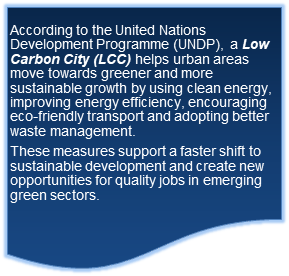
The sources primarily focus on the government’s strategic framework and do not detail specific governance challenges such as land acquisition issues, environmental clearance delays, or federal coordination challenges. However, the programme addresses potential ecological degradation by transitioning towards Low-Carbon Cities (LCCs). This framework includes water resource conservation, solid waste recycling, and the systematic mitigation of environmental impacts through green spaces. Financing gaps are addressed through allocations like the ₹3,000 crore provided to the NICDIT in the 2026-27 budget.
Way Forward
The future of these corridors lies in sustainable urban planning and green industrial corridors. Integration of renewable energy, ESG compliance (implied by climate-conscious systems), and digital infrastructure are central to the NICDP. The government continues to utilize Public-Private Partnerships (PPP) to ensure efficient resource management and better development outcomes. Moving forward, the integration of Skill India and ongoing Ease of Doing Business reforms will remain essential to maintaining India’s global competitiveness.
Conclusion
The National Industrial Corridor Development Programme is establishing the backbone of a modern, competitive economy. By creating a nationwide network of advanced production centres, India is ensuring balanced regional development and sustainable industrialization. These corridors serve as engines of New India, driving large-scale investment and job creation while adhering to a sustainability-focused framework. Through the coordinated efforts of the NICDC and NICDIT, India is well-positioned to achieve inclusive and environmentally responsible growth, fulfilling its long-term economic aspirations. I would like to note that while the user query mentions a “$5 trillion economy” target, this specific terminology was not present in the provided sources.
Prelims question:
Question: Which of the following statements is correct regarding the current status and recent developments of India’s industrial corridors as of the Union Budget 2026-27 ?
A) The National Industrial Corridor Development Programme (NICDP) is currently implementing projects across 15 distinct industrial corridors.
B) The Tumakuru Industrial Area in Karnataka is listed as one of the four projects that have already been fully completed.
C) The Union Budget 2026-27 announced the development of an integrated East Coast Industrial Corridor with a key node at Durgapur.
D) The National Industrial Corridor Development and Implementation Trust (NICDIT) was newly established in 2026 to replace the DMICDC.
Answer: C
Mains Question:
“Industrial corridors in India have evolved into integrated and sustainable economic ecosystems rather than mere transport routes.” Discuss with reference to NICDP. Highlight the economic and environmental strategies adopted for their success. (250 words)

- Artemis II: Humanity’s Return to Lunar Space and India’s Place in the New Moon Race - April 2, 2026
- A Missed Opportunity to Guarantee Minimum Wages - March 31, 2026
- ‘India’s Growth Claims, A Clash with Data Reality’. - March 30, 2026

No Comments