


10 Oct वन अधिकार अधिनियम: दूसरा क्षेत्रीय समीक्षा सम्मेलन कोलकाता में आयोजित
✎ The Forest Rights Act, 2006, is a constitutional mandate to recognise and vest forest rights in Scheduled Tribes and Other Traditional Forest Dwellers, ensuring inclusive governance through Gram Sabha-led processes and Community…
Subject Relevance — Where This Topic Fits
- GS Paper II — Governance, Constitution, Polity, Social Justice | GS Paper III — Environment, Forest and Climate Change | GS Paper II — Welfare Schemes for Vulnerable Sections of the Population
- Prelims: Forest Rights Act (FRA), 2006, Scheduled Tribes and Other Traditional Forest Dwellers (Recognition of Forest Rights) Act, Community Forest Resource Rights (CFRR), Particularly Vulnerable Tribal Groups (PVTGs), Gram Sabha, Forest Rights Titles, Digitisation of FRA Records, Forest Rights Claim Pendency, PVTG Habitat Rights, Joint Secretary, Ministry of Tribal Affairs, Secretary, Ministry of Tribal Affairs
- Essay: Inclusive Development and Tribal Empowerment: The Role of Legal Recognition in Sustainable Forest Governance, Balancing Conservation and Livelihoods: The Challenge of Implementing the Forest Rights Act
Quick Revision: The Forest Rights Act, 2006, is a constitutional mandate to recognise and vest forest rights in Scheduled Tribes and Other Traditional Forest Dwellers, ensuring inclusive governance through Gram Sabha-led processes and Community Forest Resource Rights (CFRR).
Why is this in the news?
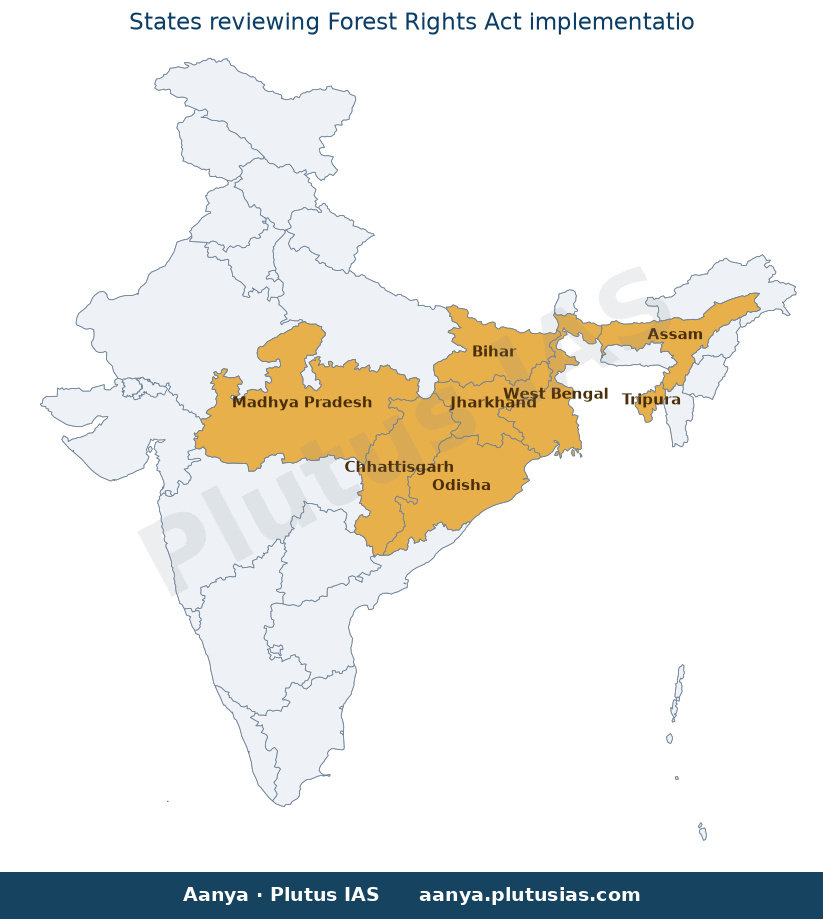
The second regional review conference on the implementation of the Forest Rights Act (FRA), 2006, was held in Kolkata on 9 October 2026, convened by the Ministry of Tribal Affairs (MoTA), Government of India. The conference brought together senior officials from eight states to assess progress on pending claims, digitisation of records, recognition of Community Forest Resource Rights (CFRR), and habitat rights for Particularly Vulnerable Tribal Groups (PVTGs). The event follows the first regional review held in Bengaluru on 10 September 2026 for southern states and underscores the government’s emphasis on district-wise, time-bound action plans to expedite FRA implementation.
Background
- The Forest Rights Act (FRA), 2006, is a landmark legislation enacted to recognise and vest forest rights in Scheduled Tribes (STs) and Other Traditional Forest Dwellers (OTFDs) who have been residing in and dependent on forest lands for generations.
- The Act aims to address historical injustices by conferring individual and community rights over forest lands, including rights to cultivate, dwell, and access forest resources, thereby promoting inclusive forest governance.
- As of 31 August 2026, over 54 lakh claims had been filed under the FRA, with approximately 25 lakh titles distributed, while 11 lakh claims remain pending and 18 lakh claims have been rejected across various states.
- States such as Madhya Pradesh, Odisha, and Assam have significant pendency in FRA claim processing, necessitating targeted interventions to expedite resolution.
- The FRA mandates the recognition of Community Forest Resource Rights (CFRR), which empower Gram Sabhas to manage and conserve forest resources collectively, aligning with the principles of decentralised governance.
- Particularly Vulnerable Tribal Groups (PVTGs) face unique challenges in securing habitat rights and livelihood support, requiring tailored policy frameworks and institutional mechanisms for effective implementation.
What is the Forest Rights Act (FRA), 2006?
- The Forest Rights Act, 2006, is a central legislation enacted under Article 244(1) of the Constitution, read with the Fifth Schedule, to recognise and vest forest rights in Scheduled Tribes and Other Traditional Forest Dwellers (OTFDs) who have been residing in and dependent on forest lands for generations.
- The Act provides for the recognition of three types of rights: (a) Title Rights (individual rights over cultivated land), (b) Use Rights (rights to access and use forest resources), and (c) Community Rights (rights over common forest resources, including Community Forest Resource Rights — CFRR).
- The FRA vests the Gram Sabha with the authority to initiate the process of determining forest rights, ensuring participatory and democratic governance in forest management.
- The Act mandates the formation of Forest Rights Committees at the Gram Sabha level to facilitate the process of claim filing, verification, and recognition of rights.
- The FRA requires the convergence of forest rights with livelihood schemes, such as the Mahatma Gandhi National Rural Employment Guarantee Scheme (MGNREGS) and other welfare programmes, to enhance the socio-economic well-being of forest-dependent communities.
- The Act also recognises the habitat rights of Particularly Vulnerable Tribal Groups (PVTGs), ensuring their cultural and ecological continuity through tailored policy interventions.
- The FRA operates in conjunction with the Scheduled Tribes and Other Traditional Forest Dwellers (Recognition of Forest Rights) Rules, 2008, which provide procedural clarity for the implementation of the Act.
- The Act is a critical instrument for achieving the Sustainable Development Goals (SDGs), particularly SDG 1 (No Poverty), SDG 2 (Zero Hunger), SDG 10 (Reduced Inequalities), and SDG 15 (Life on Land).
Key Features
| Feature | Significance |
|---|---|
| Forest Rights Act (FRA), 2006 | Constitutional recognition of forest-dwelling tribal and other traditional forest-dwelling communities’ rights over forest land and resources, ensuring legal security of tenure and livelihoods. |
| Community Forest Resource Rights (CFRR) | Empowers Gram Sabhas to manage, protect, and conserve forest resources, aligning conservation with community livelihoods and traditional knowledge systems. |
| Scheduled Tribes and Other Traditional Forest Dwellers (Recognition of Forest Rights) Rules, 2008 | Provides procedural framework for claim filing, verification, and issuance of rights titles, ensuring transparency and accountability in implementation. |
| Digitisation of FRA records | Facilitates real-time tracking of claims, reduces duplication, and enables convergence with welfare schemes for accurate beneficiary identification. |
| District-level review mechanism | Ensures time-bound resolution of pending claims, accountability of district authorities, and alignment with local governance structures like Gram Sabhas. |
Why it Matters
Legal and Constitutional
- Reinforces constitutional guarantees under Articles 14, 19(1)(g), and 21 for forest-dwelling communities, ensuring dignity and livelihood security.
- Operationalises the Fifth and Sixth Schedules by vesting rights in Scheduled Tribes and other traditional forest dwellers, strengthening self-governance in tribal areas.
Socio-Economic
- Enhances food security and livelihoods by securing land tenure and access to forest resources for over 54 lakh claimants.
- Promotes sustainable forest management through community-led conservation, reducing deforestation and enhancing biodiversity.
Administrative
- Establishes a multi-departmental coordination mechanism (Forest, Revenue, Tribal Affairs) for streamlined implementation.
- Introduces district-level accountability through time-bound action plans, reducing pendency in claim processing.
Environmental
- Aligns with India’s climate commitments under the Paris Agreement by promoting community-based forest conservation.
- Supports the National Forest Policy, 2023, which emphasises participatory forest governance.
Challenges
1. Pendency in Claim Processing
- As of 31 August 2026, approximately 11 lakh claims remain pending across states, with high concentrations in Madhya Pradesh, Odisha, and Assam.
- Delays stem from procedural bottlenecks, inadequate documentation, and lack of awareness among forest-dwelling communities.
UPSC Link: GS-II: Governance, GS-III: Environment
2. Rejection of Claims
- Over 18 lakh claims have been rejected, often due to flawed verification processes or lack of evidence from claimants.
- Rejections disproportionately affect marginalised groups, including Particularly Vulnerable Tribal Groups (PVTGs), exacerbating socio-economic disparities.
UPSC Link: GS-II: Governance, GS-III: Social Justice
3. Digitisation and Data Integration Gaps
- Incomplete digitisation of FRA records in several states hinders real-time monitoring and convergence with welfare schemes.
- Lack of inter-departmental data sharing between Forest and Revenue departments delays title issuance and claim resolution.
UPSC Link: GS-II: E-Governance, GS-III: Technology
4. Capacity Constraints in Gram Sabhas
- Gram Sabhas often lack technical and administrative capacity to prepare Community Forest Resource Management Plans (CFRMPs).
- Limited awareness among tribal communities about their rights under FRA and the process for filing claims.
UPSC Link: GS-II: Decentralised Governance, GS-III: Social Sector
5. Recognition of PVTG Habitat Rights
- PVTGs face unique challenges in securing habitat rights due to nomadic lifestyles and lack of fixed settlements.
- Slow progress in recognising habitat rights undermines the FRA’s objective of protecting the most vulnerable tribal groups.
UPSC Link: GS-II: Social Justice, GS-III: Tribal Welfare
Challenges — UPSC Perspective
| Issue | Concern |
|---|---|
| Lack of Awareness | Forest-dwelling communities, especially in remote areas, are often unaware of FRA provisions and claim processes. |
| Procedural Delays | Multi-stage verification processes, including forest and revenue department coordination, lead to prolonged pendency. |
| Inadequate Documentation | Claimants struggle to provide required evidence (e.g., land records, community consent) due to historical disenfranchisement. |
| Inter-Departmental Coordination | Poor synergy between Forest, Revenue, and Tribal Affairs departments delays claim resolution. |
| Technical Capacity Gaps | Gram Sabhas and district officials lack training to prepare CFRMPs or handle digital claim processing systems. |
| Legal Ambiguities | Interpretation of ‘forest land’ and ‘critical wildlife habitats’ under FRA often leads to disputes and rejections. |
Government Initiatives — Must-Memorise for Prelims
- Scheduled Tribes and Other Traditional Forest Dwellers (Recognition of Forest Rights) Act, 2006
- Scheduled Tribes and Other Traditional Forest Dwellers (Recognition of Forest Rights) Rules, 2008
- Tribal Sub-Plan (TSP) / Tribal Area Sub-Plan (TASP)
- Digital India Initiative (for digitisation of land records)
Way Forward
- Constitute district-level task forces comprising Forest, Revenue, and Tribal Affairs officials to expedite pending claims within a 6-month timeframe.
- Launch mass awareness campaigns in tribal languages to educate communities about FRA provisions, claim processes, and grievance redressal mechanisms.
- Accelerate digitisation of FRA records and integrate them with state land records (e.g., Bhu-Naksha, Bhulekh) for seamless verification.
- Strengthen Gram Sabha capacity through training programmes on Community Forest Resource Management Plan (CFRMP) preparation and implementation.
- Establish a grievance redressal mechanism at the district level, with dedicated helplines and mobile units for claimants in remote areas.
- Prioritise PVTG habitat rights recognition by developing state-specific roadmaps in consultation with tribal institutions and Gram Sabhas.
- Enhance inter-departmental coordination through regular joint reviews and shared digital dashboards for real-time monitoring.
- Converge FRA titles with welfare schemes (e.g., PM-KISAN, MGNREGA) to ensure livelihood support for titled beneficiaries.
UPSC Value Addition
Keywords for Mains Answer-Writing
Forest Rights Act 2006 · Scheduled Tribes and Other Traditional Forest Dwellers (Recognition of Forest Rights) Act · Community Forest Resource Rights (CFRR) · Particularly Vulnerable Tribal Groups (PVTGs) · Gram Sabha · Digitalisation of forest rights records · Pending claims under FRA · Tribal Sub-Plan (TSP) and Article 275(1) · Forest governance and tribal livelihoods · Convergence of livelihood schemes with FRA titles
Constitutional & Policy Linkages
- Fifth Schedule (Article 244(1)) – Administration and control of Scheduled Areas
- Sixth Schedule (Articles 244(2) and 257B) – Autonomous District Councils in tribal areas
- Article 21 – Right to Life and Personal Liberty (includes livelihood security)
- Article 14 – Right to Equality (non-discrimination in claim processing)
- Article 19(1)(g) – Right to practise any profession or occupation (includes forest-based livelihoods)
Concept Flow
Forest-dwelling communities face historical exclusion from forest land and resources → FRA, 2006 enacted to recognise and vest rights in Scheduled Tribes and other traditional forest dwellers → Claims filed by Gram Sabhas and individuals for individual and community rights → Verification by Forest and Revenue departments → Issuance of rights titles upon approval → Digitisation of records for transparency and convergence with welfare schemes → Implementation of Community Forest Resource Management Plans (CFRMPs) by Gram Sabhas → Sustainable forest conservation and livelihood enhancement → Alignment with constitutional provisions (Fifth/ Sixth Schedule, Articles 14, 19, 21) and national policies (National Forest Policy, 2023)
Prelims Practice Questions
Q1. Consider the following statements regarding the Forest Rights Act (FRA), 2006:
1. The FRA recognises the rights of forest-dwelling Scheduled Tribes and other traditional forest dwellers to forest land and resources.
2. The Gram Sabha plays a central role in the recognition and vesting of forest rights under the Act.
3. The Act mandates the digitalisation of all forest rights records within one year of its enactment.
4. Community Forest Resource Rights (CFRR) can be granted to Gram Sabhas for the management of forest resources.
How many of the above statements are correct?
- Only one
- Only two
- Only three
- All four
Answer: All four — Statements 1, 2, and 4 are correct. Statement 3 is incorrect as the FRA does not mandate digitalisation within one year; it is a progressive measure encouraged under recent reviews.
Q2. Assertion (A): The Particularly Vulnerable Tribal Groups (PVTGs) are a subset of Scheduled Tribes identified for their pre-agricultural level of technology and stagnant or declining population.
Reason (R): The FRA, 2006, provides for the recognition of habitat rights for PVTGs to ensure their socio-economic development and cultural preservation.
Code:
- Both A and R are true, and R is the correct explanation of A
- Both A and R are true, but R is not the correct explanation of A
- A is true, but R is false
- A is false, but R is true
Answer: A is true, but R is false — Assertion (A) is true as PVTGs are defined by their socio-economic vulnerability. Reason (R) is also true but does not directly explain the definition in (A); it pertains to a provision under the FRA.
Q3. Match the following pairs related to the Forest Rights Act (FRA), 2006:
Column I (Provision) | Column II (Description)
———————————————–|————————————
A. Community Forest Resource Rights (CFRR) | 1. Recognition of individual or community claims to forest land
B. Habitat Rights for PVTGs | 2. Rights over non-timber forest products and biodiversity
C. Individual Forest Rights (IFR) | 3. Rights to traditional and customary habitat for PVTGs
D. Gram Sabha’s role | 4. Primary authority for vesting and managing forest rights
Select the correct match:
- A-2, B-3, C-1, D-4
- A-1, B-2, C-3, D-4
- A-4, B-1, C-2, D-3
- A-3, B-4, C-1, D-2
Answer: A-2, B-3, C-1, D-4 — A-2 (CFRR grants rights over non-timber forest products and biodiversity), B-3 (Habitat Rights for PVTGs), C-1 (IFR recognises individual or community claims to forest land), D-4 (Gram Sabha is the primary authority for vesting and managing forest rights).
Mains Practice Question
✍ The Forest Rights Act (FRA), 2006, seeks to recognise and vest forest rights in Scheduled Tribes and other traditional forest dwellers, thereby empowering Gram Sabhas and enhancing forest governance. Critically examine the implementation challenges faced by the Act, with particular reference to the recognition of Community Forest Resource Rights (CFRR) and the rights of Particularly Vulnerable Tribal Groups (PVTGs). Also, assess the role of digitalisation and convergence of livelihood schemes in addressing these challenges. (15 Marks)
Approach: MODEL-ANSWER SKELETON:
1. **Introduction (2 marks)**
– Briefly state the objectives of the FRA, 2006: recognition of forest rights, empowerment of Gram Sabhas, and sustainable forest governance.
– Highlight the constitutional and statutory basis (Article 275(1) for Tribal Sub-Plan, PESA 1996, and FRA 2006).
2. **Implementation Challenges (5 marks)**
– **Pending claims and rejections**: Cite data from the recent review (e.g., 11 lakh pending claims, 18 lakh rejections) and discuss procedural bottlenecks (e.g., lack of awareness, bureaucratic delays, and inter-departmental conflicts between Revenue and Forest Departments).
– **CFRR recognition**: Explain the legal framework (Section 3(1)(i) of FRA) and challenges in mapping, documentation, and recognition of community rights due to overlapping claims, lack of technical capacity, and resistance from forest departments.
– **PVTG habitat rights**: Discuss the unique vulnerabilities of PVTGs (e.g., Korwa, Birhor) and challenges in recognising habitat rights under FRA (e.g., lack of clear guidelines, encroachment by non-tribals, and inadequate participatory processes).
3. **Role of Digitalisation and Convergence (5 marks)**
– **Digitalisation of records**: Explain how digitalisation (e.g., GIS mapping, blockchain for land records) can streamline claim processing, reduce corruption, and improve transparency. Cite examples from Andhra Pradesh’s best practices.
– **Convergence with livelihood schemes**: Discuss the integration of FRA titles with schemes like MGNREGA, PM-KISAN, and forest-based livelihood programs (e.g., Van Mitra Yojana) to enhance economic security. Highlight the need for inter-ministerial coordination (MoTA, MoEFCC).
– **Gram Sabha empowerment**: Emphasise the role of Gram Sabha in decision-making (Section 5 of FRA) and capacity-building (e.g., through D-A-JGU schemes) for sustainable forest management.
4. **Way Forward (3 marks)**
– **Policy recommendations**: Suggest time-bound district-wise action plans, strengthening of Gram Sabha institutions, and capacity-building for forest officials and tribal communities.
– **Judicial and administrative reforms**: Recommend periodic judicial reviews of rejected claims and administrative reforms to reduce delays.
– **Balanced approach**: Stress the need to balance conservation goals (e.g., CAMPA funds, wildlife protection) with tribal rights to avoid conflicts.
**Key provisions to cite**:
– Section 3(1)(a) to (i) of FRA (types of rights).
– Section 5 (role of Gram Sabha).
– Rule 12 (procedure for recognition of rights).
– PESA 1996 (extension of FRA to Fifth Schedule areas).
**Recent developments**:
– Second Regional Review Conference (October 2026) outcomes (e.g., focus on CFRR, PVTG habitat rights, and digitalisation).
– Judicial precedents (e.g., *T.N. Godavarman Thirumulpad v. Union of India* on forest governance).
**Scholarly references**:
– Viramma et al. (1994) on tribal rights and forest governance.
– Madhav Gadgil and Ramachandra Guha on ecological conflicts.
**Balanced view**:
– Acknowledge successes (e.g., Odisha and Chhattisgarh leading in IFR recognition).
– Critique failures (e.g., Jharkhand and Assam lagging in CFRR recognition).
Source: PIB (Press Information Bureau)
West Bengal PCS (WBPSC / WBCS) — State PCS Practice
Prelims: The Second Regional Review Conference on the implementation of the Forest Rights Act (FRA) was held in which city in West Bengal?
- Kolkata
- Siliguri
- Darjeeling
- Malda
Answer: Kolkata — The Second Regional Review Conference on FRA implementation was organized in Kolkata to assess progress and challenges in West Bengal.
Mains: Discuss the significance of the Forest Rights Act (FRA) in the context of West Bengal’s tribal communities and the outcomes expected from the Second Regional Review Conference held in Kolkata.
Generated by AanyaAi for educational purpose.
Related guides on our sites
- Anthropology VS PSIR
- Best PSIR optional coaching
- Best PSIR optional coaching online
- Best PSIR optional teacher

- MP CM hands over Swamitva Yojana land records in Harda - October 10, 2026
- ‘मेरा स्वास्थ्य, मेरा गौरव’ अभियान: 1.06 लाख युवाओं ने नशा मुक्ति का लिया संकल्प - October 10, 2026
- Dr. Jitendra Singh Urges Industry to Boost Indian Innovations by 2047 - October 10, 2026

No Comments