


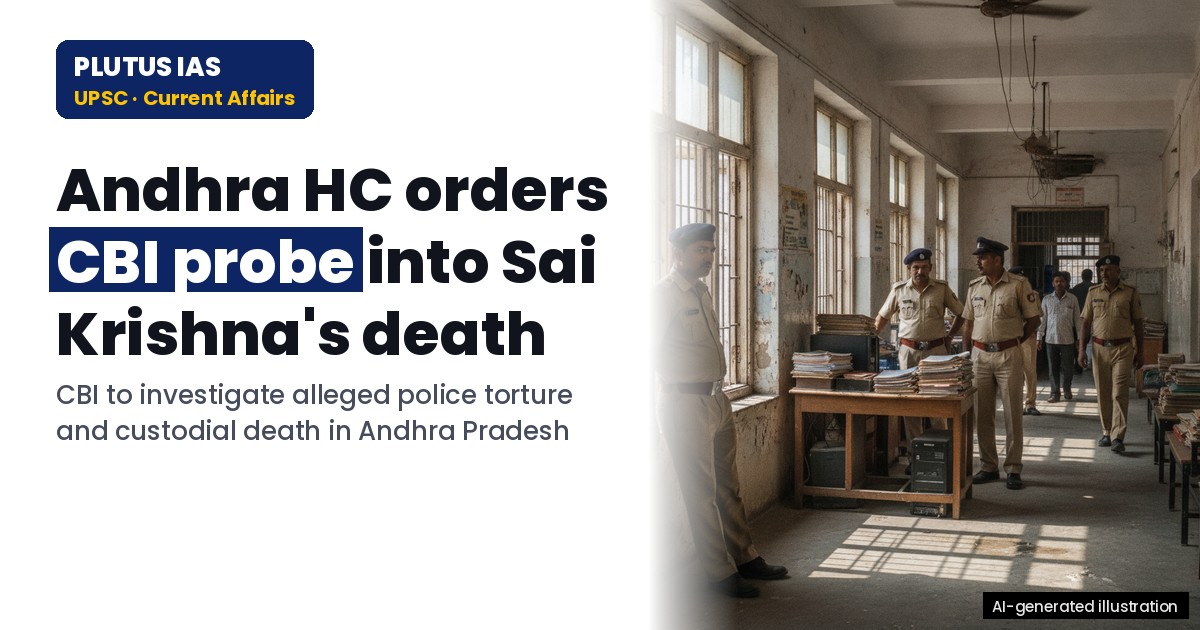
16 Oct Andhra Pradesh HC orders CBI probe into Gade Sai Krishna’s custodial death
✎ Custodial deaths violate Article 21; judicial magistrates must inquire under Section 176 CrPC, and the CBI may investigate if state agencies are compromised, as per the Delhi Special Police Establishment Act, 1946.
Subject Relevance — Where This Topic Fits
- GS Paper II — Fundamental Rights and Judicial Review | GS Paper III — Issues Relating to Policing and Human Rights
- Prelims: Custodial violence, Article 21, Habeas Corpus, CBI, Police reforms, NHRC guidelines, Section 176 CrPC, Magistrate’s powers under Section 167 CrPC, Judicial overreach vs. executive autonomy, Right to fair investigation (Article 20(3))
- Essay: The Role of Judiciary in Upholding Constitutional Safeguards Against Custodial Violence, Balancing Law Enforcement Imperatives with Human Rights in Democratic Governance
Quick Revision: Custodial deaths violate Article 21; judicial magistrates must inquire under Section 176 CrPC, and the CBI may investigate if state agencies are compromised, as per the Delhi Special Police Establishment Act, 1946.
Why is this in the news?
The Andhra Pradesh High Court’s order on 16 October 2026 transferring the investigation of the alleged custodial death of Gade Sai Krishna to the Central Bureau of Investigation (CBI) underscores the judiciary’s role in ensuring impartial inquiry into grave violations of constitutional rights. The case, involving allegations of torture, tampering with evidence, and procedural lapses by police personnel, highlights systemic deficiencies in custodial safeguards and the judiciary’s intervention to restore public trust in investigative institutions.
Background
- Custodial violence remains a persistent challenge in India despite constitutional guarantees under Article 21 (Right to Life and Personal Liberty) and statutory protections such as the Protection of Human Rights Act, 1993.
- The National Human Rights Commission (NHRC) has repeatedly emphasised the need for zero-tolerance policies against custodial torture, citing over 1,700 deaths in police custody between 2010 and 2020 (NHRC Annual Reports).
- The Supreme Court, in landmark judgments such as *D.K. Basu v. State of West Bengal* (1997) and *Prakash Singh v. Union of India* (2006), laid down stringent guidelines for police conduct, including mandatory recording of arrests, production before magistrates, and accountability mechanisms.
- State-level Special Investigation Teams (SITs) are often constituted to probe high-profile custodial deaths, but concerns persist regarding their independence and efficacy, necessitating higher-level oversight.
- The absence of CCTV footage in the Krishnalanka police station, as reported in this case, raises questions about institutional transparency and the adequacy of monitoring mechanisms in detention facilities.
What constitutes a custodial death, and what are the legal and institutional safeguards?
- Custodial death refers to the death of a person while in the custody of law enforcement agencies, including police stations, jails, or during transit to such facilities. It encompasses deaths due to torture, neglect, or unnatural causes.
- Constitutional safeguards: Article 21 guarantees the right to life and personal liberty, which the Supreme Court has interpreted to include protection from custodial violence (*D.K. Basu v. State of West Bengal*).
- Statutory provisions: Section 176 of the Code of Criminal Procedure (CrPC) mandates a judicial magistrate’s inquiry into deaths in police custody, while Section 167 CrPC requires the production of an arrested person before a magistrate within 24 hours.
- Judicial guidelines: The Supreme Court in *D.K. Basu* (1997) and *Prakash Singh* (2006) prescribed mandatory procedures, including the use of registers for arrests, medical examinations, and video recording of interrogations.
- Role of the NHRC: The Commission investigates complaints of custodial violence and recommends compensation, though its recommendations are not binding on state governments.
- CBI’s jurisdiction: The Central Bureau of Investigation can investigate cases referred by state governments or the Supreme Court under Section 6 of the Delhi Special Police Establishment Act, 1946, particularly when public confidence in state agencies is compromised.
- Police reforms: The Prakash Singh judgment directed states to implement seven key reforms, including the establishment of State Security Commissions and Police Complaints Authorities, though compliance remains uneven.
- International standards: India is a signatory to the UN Convention Against Torture (CAT), which obligates states to prevent and punish custodial torture, though domestic legislation (e.g., the Torture Bill) remains pending.
Key Features
| Feature | Significance |
|---|---|
| Judicial Intervention | The Andhra Pradesh High Court’s order transferring the investigation to the CBI underscores the judiciary’s role in ensuring impartiality in cases involving alleged state excesses, particularly custodial deaths. |
| Central Bureau of Investigation (CBI) | The CBI’s involvement is significant as it is mandated to investigate cases of national importance or where local agencies may lack credibility, ensuring a fair and unbiased probe. |
| Special Investigation Team (SIT) | The State government’s SIT, initially tasked with the probe, highlights the need for multi-tiered investigations in sensitive cases, though its findings were contested, necessitating external oversight. |
| Custodial Death | The alleged custodial death of Gade Sai Krishna raises critical concerns about police brutality, procedural lapses, and the violation of fundamental rights under Article 21 of the Constitution. |
| Habeas Corpus Petition | The filing of a habeas corpus petition by Sai Krishna’s mother brought the case to judicial notice, demonstrating the judiciary’s role in protecting individual liberty against arbitrary state action. |
Why it Matters
Legal and Judicial
- The High Court’s order reflects the judiciary’s proactive stance in safeguarding constitutional rights, particularly in cases involving state agencies.
- The transfer of the probe to the CBI sets a precedent for judicial oversight in custodial death cases, ensuring accountability and transparency.
- The case underscores the importance of habeas corpus petitions in exposing state excesses and protecting individual liberties.
Governance and Accountability
- The incident highlights systemic failures in police custody, including procedural lapses, tampering with evidence (CCTV footage), and delayed FIR registration.
- The State government’s formation of an SIT demonstrates the need for structured investigations, though external oversight (CBI) was deemed necessary for credibility.
- The case raises questions about the efficacy of internal police oversight mechanisms and the need for independent investigations in custodial death cases.
Human Rights
- The alleged custodial death of Gade Sai Krishna is a grave violation of human rights, particularly the right to life and dignity under Article 21 of the Constitution.
- The case highlights the vulnerability of individuals in police custody and the urgent need for reforms to prevent such incidents.
- The judiciary’s intervention in this case reinforces the state’s obligation to protect citizens from state-sponsored violence.
Challenges
1. Ensuring Impartial Investigations
- The initial investigation by the State SIT faced credibility issues, necessitating judicial intervention and transfer to the CBI.
- The case highlights the challenge of ensuring impartiality in investigations involving state agencies, particularly the police.
- The missing CCTV footage and alleged tampering with evidence underscore the difficulties in gathering reliable information in custodial death cases.
UPSC Link: GS2: Judiciary and CBI
2. Police Reforms and Accountability
- The case exposes systemic failures in police custody, including procedural lapses, delayed FIR registration, and lack of transparency.
- The alleged involvement of a police officer in the custodial death raises questions about the efficacy of internal accountability mechanisms.
- The need for comprehensive police reforms to prevent custodial deaths and ensure accountability is evident.
UPSC Link: GS2: Police Reforms
3. Judicial Oversight in Custodial Deaths
- The High Court’s order to transfer the probe to the CBI demonstrates the judiciary’s role in ensuring accountability in custodial death cases.
- The case highlights the need for proactive judicial intervention to prevent state excesses and protect individual liberties.
- The judiciary’s role in issuing habeas corpus petitions and ordering investigations is crucial in safeguarding constitutional rights.
UPSC Link: GS2: Judiciary and Fundamental Rights
4. Public Trust in Law Enforcement
- The alleged custodial death and subsequent investigations have eroded public trust in law enforcement agencies.
- The case underscores the need for transparency and accountability in police operations to restore public confidence.
- The involvement of the CBI in the probe is a step toward rebuilding trust in the justice delivery system.
UPSC Link: GS2: Law and Order
Challenges — UPSC Perspective
| Issue | Concern |
|---|---|
| Impartial Investigations | Ensuring that investigations into custodial deaths are free from bias and conducted by an independent agency. |
| Police Accountability | Addressing systemic failures in police custody, including procedural lapses and lack of transparency. |
| Judicial Oversight | Strengthening the judiciary’s role in monitoring and intervening in cases involving state excesses. |
| Public Trust | Rebuilding public confidence in law enforcement agencies through transparent and accountable operations. |
| Evidence Tampering | Preventing the destruction or manipulation of evidence, such as CCTV footage, in custodial death cases. |
Way Forward
- Strengthen judicial oversight in custodial death cases by mandating automatic judicial inquiries in all such incidents.
- Implement comprehensive police reforms, including stricter accountability mechanisms and transparency in custody procedures.
- Ensure the independence of investigative agencies like the CBI by providing constitutional safeguards against political interference.
- Enhance training for police personnel on human rights, procedural compliance, and the use of non-violent methods in custody.
- Establish a national database for custodial deaths to track patterns, identify systemic issues, and ensure accountability.
- Mandate the installation and maintenance of tamper-proof CCTV systems in all police stations and detention centers.
- Promote public awareness campaigns on legal rights and remedies available to individuals in police custody.
UPSC Value Addition
Keywords for Mains Answer-Writing
Custodial death · Central Bureau of Investigation (CBI) · Andhra Pradesh High Court · Special Investigation Team (SIT) · Police reforms · Judicial oversight · Constitutional safeguards · Supreme Court directives · Human rights violations · Magisterial remand · Custody jurisprudence · Rule of law
Constitutional & Policy Linkages
- Article 21: Protection of Life and Personal Liberty (Right to Dignity and Fair Trial)
- Article 32: Right to Constitutional Remedies (Judicial Intervention in Custodial Deaths)
- Article 22: Protection against Arrest and Detention (Safeguards in Custody)
Concept Flow
Alleged custodial death of Gade Sai Krishna → Habeas corpus petition filed by mother → State SIT formed → Findings contested → High Court orders CBI probe → CBI investigation initiated → Judicial oversight ensures accountability. → Police custody → Alleged torture and death → Missing CCTV footage → Tampering with evidence → Delayed FIR registration → Judicial intervention → Transfer to CBI. → State government forms SIT → SIT investigates → Findings challenged → High Court intervenes → CBI takes over → Ensures impartiality and transparency. → Custodial death → Violation of Article 21 → Right to life and dignity infringed → Judicial remedy under Article 32 → CBI probe ordered → Accountability ensured. → Police excesses → Systemic failures → Lack of accountability → Erosion of public trust → Judicial intervention → Reforms initiated.
Prelims Practice Questions
Q1. Consider the following statements regarding the Central Bureau of Investigation (CBI) in India:
1. The CBI is a statutory body established under the Delhi Special Police Establishment Act, 1946.
2. The CBI can take up investigation of any offence without the consent of the State government.
3. The CBI is under the administrative control of the Ministry of Home Affairs.
How many of the above statements are correct?
- Only one
- Only two
- All three
- None
Answer: Only two — Statement 1 is correct as the CBI derives its legal foundation from the Delhi Special Police Establishment Act, 1946. Statement 2 is incorrect because the CBI requires the consent of the State government to investigate offences within the State’s jurisdiction under Section 6 of the Act. Statement 3 is correct as the CBI operates under the administrative supervision of the Ministry of Home Affairs.
Q2. Assertion (A): The Supreme Court of India has the power to transfer an investigation from a State police force to the CBI under Article 32 of the Constitution.
Reason (R): The Supreme Court can exercise its writ jurisdiction to ensure the protection of fundamental rights, including the right to life and personal liberty under Article 21.
Options:
A. Both A and R are true, and R is the correct explanation of A.
B. Both A and R are true, but R is not the correct explanation of A.
C. A is true, but R is false.
D. A is false, but R is true.
Answer: ? — Assertion (A) is true as the Supreme Court can transfer investigations to the CBI under its writ jurisdiction to protect fundamental rights. Reason (R) is also true and correctly explains the legal basis for such transfers, as Article 32 empowers the Court to enforce fundamental rights.
Q3. Match the following provisions with their respective legal frameworks:
Column I (Provision)
A. Custodial death compensation
B. Protection against arrest and detention
C. Right to fair investigation
D. Transfer of investigation to CBI
Column II (Legal Framework)
1. Article 22 of the Constitution
2. Section 176 of the Code of Criminal Procedure, 1973
3. NHRC Guidelines on Custodial Deaths
4. Supreme Court’s writ jurisdiction under Article 32
- A-3, B-1, C-2, D-4
- A-2, B-1, C-3, D-4
- A-3, B-4, C-2, D-1
- A-1, B-2, C-3, D-4
Answer: A-3, B-1, C-2, D-4 — A-3: NHRC Guidelines provide for compensation in custodial deaths. B-1: Article 22 protects individuals against arbitrary arrest and detention. C-2: Section 176 CrPC mandates a magisterial inquiry in cases of custodial death. D-4: The Supreme Court can transfer investigations to the CBI under its writ jurisdiction.
Mains Practice Question
✍ The Andhra Pradesh High Court’s decision to transfer the investigation of Gade Sai Krishna’s alleged custodial death to the CBI underscores the judiciary’s role in upholding constitutional safeguards against state excesses. Critically analyse the constitutional and legal framework governing custodial deaths in India. Also, elucidate the institutional mechanisms available to victims’ families for redressal. (15 Marks)
Approach: MODEL-ANSWER SKELETON:
1. **Constitutional Safeguards**:
– Article 21 (Right to Life and Personal Liberty) and Article 22 (Protection against arrest and detention) as the bedrock of custodial safeguards.
– Judicial precedents: DK Basu v. State of West Bengal (1997) and Prakash Singh v. Union of India (2006) laying down guidelines for police reforms and custodial torture.
– Supreme Court’s directive in Nilabati Behera v. State of Orissa (1993) on compensation for custodial deaths.
2. **Legal Framework**:
– Section 176 of the Code of Criminal Procedure, 1973 mandating a magistrate’s inquiry in cases of custodial death.
– Sections 302, 304, and 34 of the Indian Penal Code for offences of murder, culpable homicide, and common intention.
– Protection of Human Rights Act, 1993 and NHRC Guidelines on Custodial Deaths (1993) providing for compensation and inquiry.
3. **Institutional Mechanisms**:
– Role of the Supreme Court under Article 32 and High Courts under Article 226 for judicial intervention.
– Transfer of investigations to the CBI under the Supreme Court’s writ jurisdiction to ensure impartiality.
– Role of the National Human Rights Commission (NHRC) and State Human Rights Commissions in monitoring and redressal.
4. **Challenges and Gaps**:
– Delay in registration of FIRs and magisterial remand.
– Lack of transparency in police investigations and tampering with evidence (e.g., missing CCTV footage).
– Need for systemic reforms in police accountability and training.
5. **Redressal for Victims’ Families**:
– Access to judicial remedies under Articles 32/226.
– Compensation under NHRC guidelines and judicial precedents.
– Role of civil society and media in highlighting cases and ensuring accountability.
Balance of views: While the judiciary provides a robust framework, systemic challenges such as institutional bias, lack of political will, and procedural delays often hinder effective redressal.
Source: The Hindu
Andhra Pradesh PCS (APPSC) — State PCS Practice
Prelims: Which constitutional provision empowers the Andhra Pradesh High Court to transfer the investigation of a custodial death case to the Central Bureau of Investigation (CBI)?
- Article 226 of the Constitution of India
- Article 32 of the Constitution of India
- Article 142 of the Constitution of India
- Article 246 of the Constitution of India
Answer: Article 226 of the Constitution of India — Article 226 empowers the High Court to issue writs for enforcement of fundamental rights and other purposes, including directing investigations by the CBI in public interest.
Mains: Analyze the constitutional and legal provisions that enable the Andhra Pradesh High Court to transfer the probe of a custodial death case to the CBI. Discuss the implications of such transfers on federalism and state autonomy, with specific reference to Andhra Pradesh.
Generated by AanyaAi for educational purpose.
Related guides on our sites
- Anthropology VS PSIR
- Best PSIR optional coaching
- Best PSIR optional coaching online
- Best PSIR optional teacher

- विशाखापट्टनम में उच्च जोखिम गर्भावस्था की निगरानी बढ़ाने पर कलेक्टर का निर्देश, जानिए पूरी जानकारी - October 21, 2026
- National Unity Day 2026: Key Preparations & Significance for UPSC - October 21, 2026
- 14वां इंडिया केम 2026: मुंबई में वैश्विक रसायन उद्योग का महाकुंभ - October 21, 2026

No Comments