


15 Oct DMRC’s Unconditional Apology to SC Over Metro Restrictions: Key Facts Explained
✎ The Supreme Court’s intervention in Metro service restrictions underscores the constitutional principle that public order measures must not result in a complete halt of essential services, as such actions may violate fundamental…
Subject Relevance — Where This Topic Fits
- GS Paper II — Functions and Responsibilities of the Union and the States, Issues and Challenges Pertaining to the Federal Structure | GS Paper III — Infrastructure: Energy, Ports, Roads, Airports and Urban Transport
- Prelims: Metro Rail Safety Authority, Public Order, Contempt of Court, Fundamental Duties, Urban Local Bodies, Metro Rail Act, 2002, Supreme Court of India, Delhi Metro Rail Corporation (DMRC), Delhi Police
- Essay: The Role of Judiciary in Ensuring Governance Accountability in Urban Infrastructure, Balancing Public Order and Public Utility: A Study of Transport Networks in Metropolitan Cities
Quick Revision: The Supreme Court’s intervention in Metro service restrictions underscores the constitutional principle that public order measures must not result in a complete halt of essential services, as such actions may violate fundamental rights under Articles 19(1)(d) and 21 of the Constitution.
Why is this in the news?
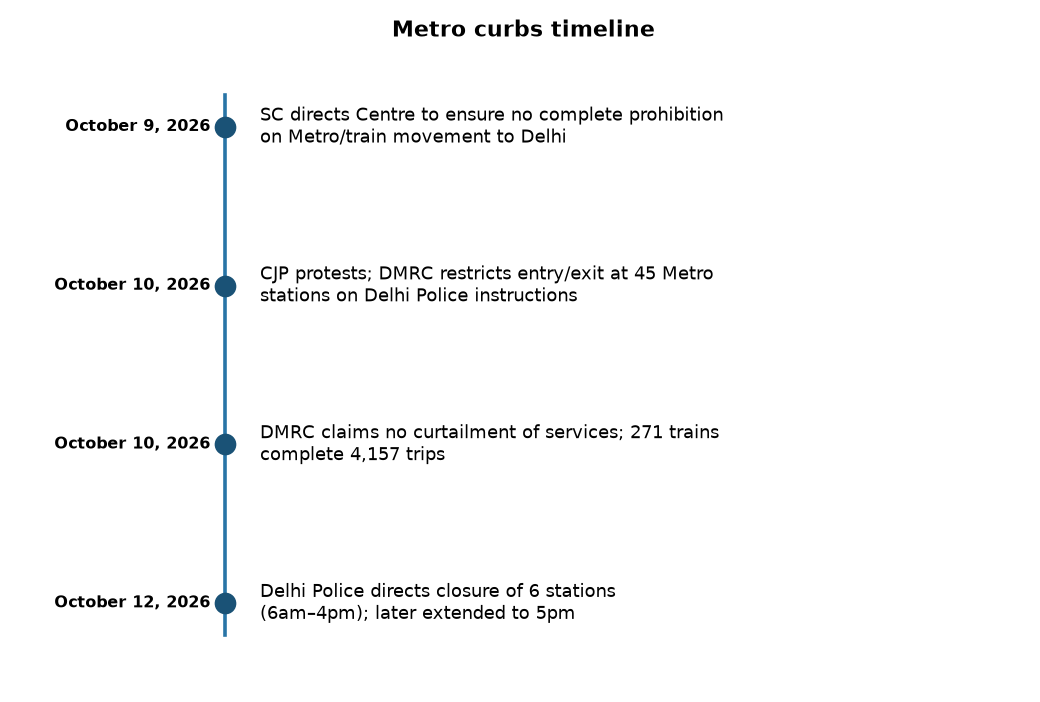
The Delhi Metro Rail Corporation (DMRC) submitted an affidavit to the Supreme Court on October 15, 2026, tendering an unconditional apology for restrictions imposed on Metro station entry and exit during protests on October 10, 2026, as per police instructions. The affidavit clarified that while certain stations faced regulated access, there was no blanket shutdown of Metro services, contradicting allegations of a complete prohibition. The Supreme Court had previously directed the Centre on October 9, 2026, to ensure no total halt in Metro operations, following petitions challenging the closure of entry and exit gates at 57 stations.
Background
- The Delhi Metro Rail Corporation (DMRC), a joint venture of the Government of India and the Government of Delhi, operates a network with 303 stations.
- Urban transport networks in India, particularly in metropolitan cities like Delhi, are governed by a complex interplay of central, state, and municipal authorities, including the Ministry of Housing and Urban Affairs, state transport departments, and city police forces.
- Public order management in urban areas often requires coordination between law enforcement agencies and public utility providers to balance the right to protest with the need for uninterrupted essential services.
- The Supreme Court of India, through its constitutional jurisdiction under Article 32 and Article 142, plays a pivotal role in resolving disputes involving fundamental rights, public order, and institutional accountability.
- Contempt of court proceedings in India are governed by the Contempt of Courts Act, 1971, which empowers courts to punish actions that obstruct the administration of justice or undermine judicial authority.
- The incident highlights the challenges of implementing restrictions on public infrastructure during protests, particularly in densely populated urban centres where mobility is critical for economic and social activities.
What are the Legal and Institutional Frameworks Governing Metro Service Restrictions in India?
- Public order management in urban areas is primarily the responsibility of state police forces under the Police Act, 1861, and the Code of Criminal Procedure, 1973. However, coordination with public utility providers, such as Metro authorities, is essential to avoid disproportionate disruptions to essential services.
- The Supreme Court’s jurisdiction under Article 32 of the Constitution empowers it to issue directions for the enforcement of fundamental rights, including the right to movement (Article 19(1)(d)) and the right to life and personal liberty (Article 21). In this case, the Court intervened to prevent a complete halt in Metro services, balancing public order with constitutional guarantees.
- Contempt of court proceedings, as governed by the Contempt of Courts Act, 1971, serve as a mechanism to ensure compliance with judicial orders. The Act defines civil contempt (willful disobedience of court orders) and criminal contempt (scandalizing the court or obstructing justice), with penalties including imprisonment or fines.
- The DMRC’s affidavit underscored the principle of proportionality in restricting access to Metro stations. While certain stations faced regulated entry and exit, the corporation maintained that 85% of the network remained fully operational, demonstrating adherence to the least intrusive measures.
- Institutional accountability in urban transport management requires transparent communication between law enforcement agencies and public utility providers. The DMRC’s use of social media, operational control centre announcements, and real-time updates exemplifies best practices in public communication during service disruptions.
- The incident also highlights the role of the Union Government in ensuring inter-state coordination, particularly when Metro services traverse multiple jurisdictions. The Ministry of Housing and Urban Affairs and the Ministry of Home Affairs may intervene to facilitate such coordination, as directed by the Supreme Court in this case.
Key Features
| Feature | Significance |
|---|---|
| Contempt notice by Supreme Court | Asserts judicial oversight over executive actions restricting public infrastructure, reinforcing the principle that judicial directions must be complied with in letter and spirit. |
| DMRC affidavit on Metro operations | Provides empirical data to demonstrate that Metro services remained largely functional despite localized restrictions, countering allegations of a blanket shutdown. |
| Police-directed entry-exit restrictions | Highlights the role of law enforcement agencies in regulating public movement, underscoring the balance between law-and-order imperatives and citizen mobility. |
| Real-time passenger communication | Emphasizes the importance of transparent public communication during disruptions to maintain commuter trust and mitigate inconvenience. |
| Protest-related disruptions | Illustrates how spontaneous civic actions can impact urban transport systems and necessitate adaptive governance responses. |
Why it Matters
Governance and Rule of Law
- Demonstrates the judiciary’s authority to intervene in executive decisions affecting public services, ensuring adherence to constitutional principles of governance.
- Reinforces the doctrine of judicial review in matters of administrative actions, particularly where fundamental rights (e.g., right to movement under Article 19(1)(d)) may be implicated.
- Highlights the accountability of public authorities (DMRC) in complying with judicial directives, even in politically sensitive contexts.
Urban Infrastructure and Mobility
- Showcases the resilience of critical urban infrastructure (Metro) in maintaining partial operations during disruptions, ensuring continuity of essential services.
- Underscores the challenges of balancing law-and-order requirements with the need for uninterrupted public transport, particularly in densely populated urban areas.
- Illustrates the role of real-time data (e.g., ridership figures, station operations) in informing policy decisions and public communication.
Public Administration and Communication
- Emphasizes the necessity of clear, timely communication between law enforcement, public authorities, and the public to manage expectations and mitigate disruptions.
- Demonstrates the use of multi-channel communication (social media, announcements, signage) to disseminate advisories during crises.
- Highlights the importance of inter-agency coordination (DMRC, Delhi Police, judiciary) in addressing complex urban challenges.
Constitutional and Legal Framework
- Raises questions about the constitutional validity of restrictions on public movement, particularly when imposed by executive authorities without explicit statutory backing.
- Examines the interplay between fundamental rights (e.g., Article 19(1)(d)) and reasonable restrictions under Article 19(2)-(6) in the context of law-and-order exigencies.
- Illustrates the role of judicial directives in clarifying the boundaries of executive discretion in regulating public infrastructure.
Challenges
1. Balancing Law-and-Order with Public Mobility
- Executive authorities face the challenge of imposing restrictions on public movement without violating constitutional guarantees of freedom of movement (Article 19(1)(d)).
- Localized restrictions (e.g., at specific Metro stations) must be justified on grounds of necessity and proportionality to avoid allegations of arbitrary governance.
- The need for real-time adaptability in governance responses to spontaneous civic actions (e.g., protests) that disrupt urban infrastructure.
UPSC Link: GS-2: Fundamental Rights & DPSP
2. Judicial Oversight vs. Executive Discretion
- The judiciary’s intervention to prevent a ‘complete prohibition’ on Metro services raises questions about the limits of judicial review in administrative actions.
- Executive agencies must ensure compliance with judicial directives while balancing competing public interests (e.g., law-and-order vs. mobility).
- The episode highlights the need for clear guidelines on the circumstances under which restrictions on public infrastructure can be imposed.
UPSC Link: GS-2: Separation of Powers
3. Public Communication During Disruptions
- Ensuring transparent and timely communication to the public during disruptions is critical to maintaining trust and minimizing inconvenience.
- Multi-channel dissemination (e.g., social media, announcements) must be coordinated to reach diverse commuter groups.
- The absence of standardized communication protocols can exacerbate public confusion and dissatisfaction.
UPSC Link: GS-4: Ethics in Governance
4. Data-Driven Governance
- The use of empirical data (e.g., ridership figures, station operations) to inform policy decisions and counter misinformation is essential for evidence-based governance.
- Public authorities must maintain robust data systems to track disruptions and their impact on service delivery.
- The episode underscores the need for standardized metrics to assess the severity of disruptions and their socio-economic impact.
UPSC Link: GS-3: Infrastructure & Data Governance
5. Inter-Agency Coordination
- Effective coordination between law enforcement (Delhi Police), public infrastructure providers (DMRC), and the judiciary is critical to managing disruptions.
- Lack of clear protocols for inter-agency communication can lead to conflicting directives and operational inefficiencies.
- The episode highlights the need for formalized frameworks to address complex urban challenges involving multiple stakeholders.
UPSC Link: GS-2: Centre-State Relations
Challenges — UPSC Perspective
| Issue | Concern |
|---|---|
| Constitutional validity of restrictions | Whether restrictions on public movement comply with Article 19(1)(d) and are justified under Article 19(2)-(6). |
| Judicial vs. executive authority | The extent to which the judiciary can direct executive actions in matters of public infrastructure and law-and-order. |
| Public communication gaps | The risk of misinformation and public dissatisfaction due to inadequate or delayed communication during disruptions. |
| Data accuracy and transparency | The need for reliable, real-time data to inform policy decisions and counter allegations of mismanagement. |
| Inter-agency coordination failures | The potential for conflicting directives and operational inefficiencies due to poor coordination between agencies. |
Way Forward
- Formulate clear, statutory guidelines for imposing restrictions on public infrastructure during law-and-order exigencies, ensuring alignment with constitutional principles.
- Develop standardized communication protocols for public authorities to disseminate timely advisories during disruptions, utilizing multiple channels (e.g., social media, announcements, signage).
- Enhance inter-agency coordination frameworks to streamline decision-making and operational responses to urban disruptions, involving law enforcement, public infrastructure providers, and local authorities.
- Invest in robust data systems to track disruptions in real-time, enabling evidence-based policy decisions and transparent public reporting.
- Conduct periodic reviews of judicial directives and executive actions to assess their impact on public services and identify areas for improvement in governance.
- Strengthen public grievance redressal mechanisms to address complaints related to disruptions in essential services, ensuring accountability and citizen-centric governance.
- Promote civic awareness campaigns to educate the public on their rights and responsibilities during disruptions, fostering a culture of cooperation and understanding.
UPSC Value Addition
Keywords for Mains Answer-Writing
Delhi Metro Rail Corporation (DMRC) · Supreme Court directives on public transport · contempt of court proceedings · public order and mobility · interplay of police powers and judicial oversight · right to movement under Article 19(1)(d) · institutional accountability in governance · public utility services regulation · judicial review of executive actions · contempt jurisdiction of Supreme Court · public order management · railway and metro services as essential services · balancing fundamental rights and public order · judicial-legislative-executive relations · contempt of court and institutional compliance
Constitutional & Policy Linkages
- Article 19(1)(d) – Right to move freely throughout the territory of India.
- Article 19(2)-(6) – Reasonable restrictions on fundamental rights in the interest of sovereignty, integrity, public order, or morality.
- Article 21 – Right to life and personal liberty, encompassing the right to livelihood and access to essential services.
Concept Flow
Protest by civic group (CJP) → Delhi Police assesses law-and-order risk → Instructions to restrict Metro entry/exit at sensitive stations → DMRC implements restrictions → Supreme Court directs Centre to ensure no ‘complete prohibition’ on Metro services → DMRC files affidavit clarifying operations → Contempt notice issued for alleged non-compliance → DMRC tenders unconditional apology and submits data to refute allegations → Judicial scrutiny of executive actions → Broader debate on balancing law-and-order with public mobility.
Prelims Practice Questions
Q1. Consider the following statements regarding the Supreme Court’s contempt jurisdiction in India:
1. The Supreme Court can initiate contempt proceedings suo motu.
2. Civil contempt includes willful disobedience of any judgment, decree, direction, order, writ or other process of a court.
3. The punishment for contempt cannot exceed simple imprisonment for a term exceeding six months.
How many of the above statements are correct?
- Only one
- Only two
- All three
- None
Answer: All three — Statements 1 and 2 are correct. The Supreme Court can initiate contempt proceedings suo motu under Article 129 of the Constitution. Civil contempt is defined under Section 2(b) of the Contempt of Courts Act, 1971, to include willful disobedience of court orders. Statement 3 is incorrect; the punishment for contempt can extend up to simple imprisonment for a term not exceeding six months or a fine not exceeding ₹2,000 or both, as per Section 12 of the Contempt of Courts Act, 1971.
Q2. Assertion (A): The right to movement under Article 19(1)(d) of the Constitution of India is subject to reasonable restrictions imposed in the interest of public order.
Reason (R): The State can impose restrictions on the right to movement to prevent public disorder, provided such restrictions are reasonable and proportionate.
Options:
A. Both A and R are true, and R is the correct explanation of A.
B. Both A and R are true, but R is not the correct explanation of A.
C. A is true, but R is false.
D. A is false, but R is true.
Answer: ? — Assertion (A) is true as Article 19(1)(d) guarantees the right to move freely throughout the territory of India, subject to reasonable restrictions under Article 19(2) for public order. Reason (R) is also true and correctly explains the limitation on the right to movement. The restrictions must be reasonable and proportionate, as held in various Supreme Court judgments such as *State of Madras v. V.G. Row* (1952).
Q3. Match the following constitutional provisions with their respective areas of operation:
Column I (Provision)
A. Article 19(1)(d)
B. Article 21
C. Article 14
D. Article 32
Column II (Area of Operation)
1. Right to life and personal liberty
2. Right to move freely throughout the territory of India
3. Right to constitutional remedies
4. Right to equality before law
Select the correct match:
- A-2, B-1, C-4, D-3
- A-1, B-2, C-3, D-4
- A-3, B-4, C-1, D-2
- A-4, B-3, C-2, D-1
Answer: A-2, B-1, C-4, D-3 — The correct match is: A-2 (Article 19(1)(d) guarantees the right to move freely throughout the territory of India), B-1 (Article 21 guarantees the right to life and personal liberty), C-4 (Article 14 guarantees equality before law), and D-3 (Article 32 guarantees the right to constitutional remedies).
Mains Practice Question
✍ The Supreme Court’s directive to ensure no complete prohibition on the movement of Metro and other trains during public protests underscores the delicate balance between public order management and fundamental rights. Critically examine the legal and constitutional principles governing this balance, with particular reference to the right to movement under Article 19(1)(d) and the powers of the police under the Code of Criminal Procedure, 1973. Also, discuss the role of judicial review in ensuring institutional accountability in such scenarios. (15 Marks)
Approach: MODEL-ANSWER SKELETON:
1. **Introduction (2 marks)**
– Briefly state the context of the Supreme Court’s directive in the DMRC case and the constitutional right to movement (Article 19(1)(d)).
– Define the scope of public order and its legal basis under Article 19(2) of the Constitution.
2. **Right to Movement and Reasonable Restrictions (3 marks)**
– Explain Article 19(1)(d) and its significance as a fundamental right.
– Discuss the permissible restrictions under Article 19(2) (e.g., public order, morality, health, or sovereignty and integrity of India).
– Cite landmark judgments such as *State of Madras v. V.G. Row* (1952) and *Maneka Gandhi v. Union of India* (1978) to highlight the proportionality test for restrictions.
3. **Police Powers and Public Order Management (3 marks)**
– Outline the powers of the police under the Code of Criminal Procedure, 1973 (e.g., Section 144 for prohibitory orders) and the Police Act, 1861.
– Discuss the doctrine of ‘least restrictive means’ and how restrictions must be narrowly tailored to achieve the objective of maintaining public order.
– Reference the *Ram Manohar Lohia v. State of Bihar* (1966) case on the distinction between ‘public order’ and ‘law and order’.
4. **Judicial Review and Institutional Accountability (4 marks)**
– Explain the role of judicial review in ensuring that executive actions do not violate fundamental rights.
– Discuss the Supreme Court’s power of judicial review under Article 32 and Article 136 of the Constitution.
– Highlight the significance of contempt jurisdiction (Article 129 and Contempt of Courts Act, 1971) in enforcing compliance with judicial directives.
– Cite the *DMRC case* to illustrate how judicial oversight ensures accountability in public utility services.
5. **Balancing Act and Contemporary Challenges (3 marks)**
– Discuss the challenges in balancing public order with fundamental rights, especially during protests or emergencies.
– Reference the *Shaheen Bagh* (2020) case to illustrate judicial balancing of rights and public order.
– Conclude with the need for clear guidelines to prevent arbitrary restrictions and ensure transparency in decision-making.
Source: The Indian Express
Generated by AanyaAi for educational purpose.
Related guides on our sites
- Best PSIR optional coaching in delhi
- Best PSIR optional coaching in delhi for UPSC
- Anthropology VS PSIR
- Best PSIR optional coaching online

- विशाखापट्टनम में उच्च जोखिम गर्भावस्था की निगरानी बढ़ाने पर कलेक्टर का निर्देश, जानिए पूरी जानकारी - October 21, 2026
- National Unity Day 2026: Key Preparations & Significance for UPSC - October 21, 2026
- 14वां इंडिया केम 2026: मुंबई में वैश्विक रसायन उद्योग का महाकुंभ - October 21, 2026

No Comments