


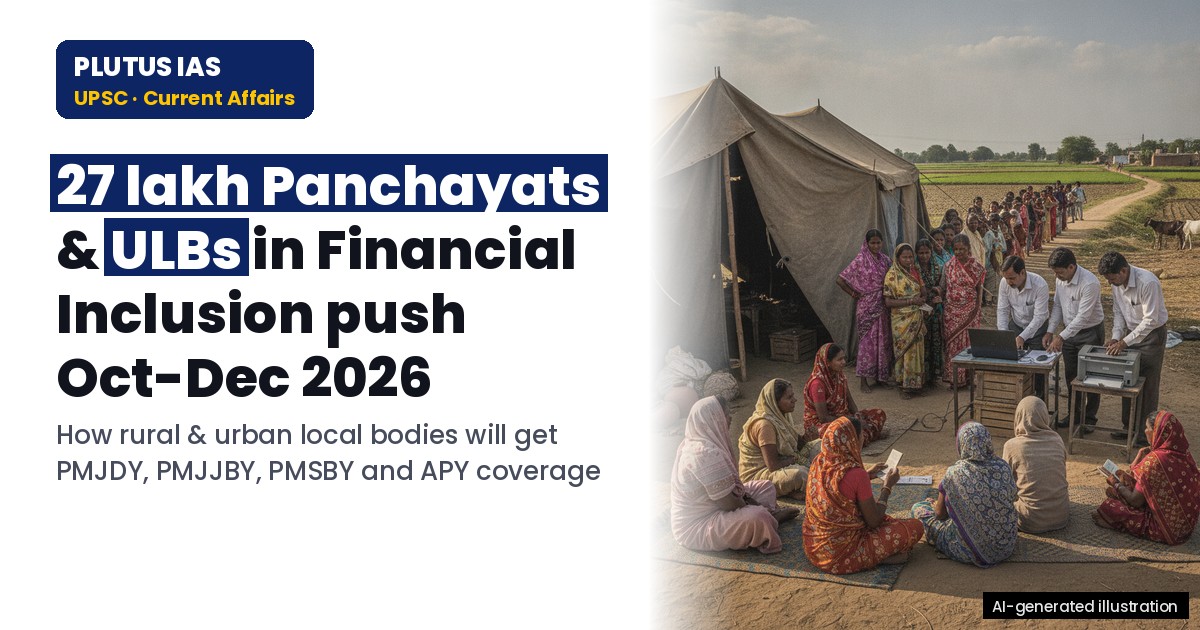
19 Oct Financial Inclusion Campaign: 27 Lakh Panchayats & ULBs Covered Oct-Dec 2026
✎ The National Financial Inclusion Campaign (21 Oct–31 Dec 2026) is a DFS-led, time-bound outreach to 27 lakh GPs/ULBs, integrating enrolment under PMJDY, PMJJBY, PMSBY, APY, KCC, and PMFBY with digital literacy and KYC updation…
Subject Relevance — Where This Topic Fits
- GS Paper III — Indian Economy: Issues relating to Planning, Mobilisation of Resources, Growth, Development and Employment
- Prelims: Financial Inclusion Index (FI-Index), PMJDY, PMJJBY, PMSBY, APY, C-KYC, Jan Dhan Darshak, Direct Benefit Transfer (DBT), Priority Sector Lending (PSL), Regional Rural Banks (RRBs), Self Help Group (SHG) Bank Linkage, Micro Units Development and Refinance Agency (MUDRA)
- Essay: Inclusive growth and equitable access to financial services as a catalyst for socio-economic transformation
Quick Revision: The National Financial Inclusion Campaign (21 Oct–31 Dec 2026) is a DFS-led, time-bound outreach to 27 lakh GPs/ULBs, integrating enrolment under PMJDY, PMJJBY, PMSBY, APY, KCC, and PMFBY with digital literacy and KYC updation, operationalising the NSFI 2019–2024 vision.
Why is this in the news?
The Department of Financial Services (DFS), Ministry of Finance, has announced a nationwide campaign from 21 October 2026 to 31 December 2026 to accelerate financial inclusion by reaching 27 lakh Gram Panchayats (GPs) and Urban Local Bodies (ULBs). The campaign integrates enrolment drives for social security schemes, account opening, KYC updation, digital literacy, and awareness on unclaimed deposits, thereby operationalising the government’s commitment to last-mile connectivity in the formal financial ecosystem.
Background
- Financial inclusion is a core objective of the Government of India, articulated in the National Strategy for Financial Inclusion (NSFI) 2019–2024, which aims to provide access to formal financial services to all households by 2024.
- Pradhan Mantri Jan Dhan Yojana (PMJDY), launched in 2014, has achieved universal coverage with over 53 crore operative accounts as of March 2026, forming the backbone of the inclusion architecture.
- The Reserve Bank of India (RBI) mandates banks to open no-frills accounts under PMJDY and to allocate 40% of Adjusted Net Bank Credit (ANBC) to the priority sector, including agriculture and micro-enterprises.
- The Financial Inclusion Index (FI-Index), introduced by RBI in 2021, measures inclusion across three dimensions—access, usage, and quality—on a scale of 0 to 100.
- The campaign aligns with the ‘Digital India’ and ‘Aspirational Districts Programme’ initiatives, leveraging digital public infrastructure (DPI) such as Aadhaar, Unified Payments Interface (UPI), and e-KYC for seamless service delivery.
- Regional Rural Banks (RRBs) and cooperative banks, designated as ‘last-mile’ institutions, play a pivotal role in extending financial services to rural and peri-urban populations.
What is the National Financial Inclusion Campaign (21 Oct–31 Dec 2026)?
- It is a time-bound, pan-India outreach initiative led by the Department of Financial Services (DFS), Ministry of Finance, to intensify enrolment and updation activities across Gram Panchayats (GPs) and Urban Local Bodies (ULBs) from 21 October to 31 December 2026.
- The campaign targets 27 lakh GPs and ULBs, ensuring that no administrative unit is left out of the formal financial fold, thereby enhancing the depth and breadth of inclusion.
- Key activities include enrolment under social security schemes (PMJJBY, PMSBY, APY), opening of PMJDY accounts, Aadhaar seeding, C-KYC registration, re-KYC of dormant accounts, and awareness sessions on digital fraud and unclaimed deposits under the ‘Aapki Punji, Aapka Adhikar’ (आपकी पूंजी, आपका अधिकार) initiative.
- The campaign integrates credit linkage for eligible PM-KISAN beneficiaries through Kisan Credit Card (KCC) enrolment and enrolment under the Pradhan Mantri Fasal Bima Yojana (PMFBY) for the upcoming Rabi season, thereby linking financial inclusion with agricultural productivity.
- Banks, in collaboration with State Level Bankers’ Committees (SLBCs), will conduct camps at GP/ULB levels, utilising digital tools such as Jan Dhan Darshak app, Aadhaar-enabled Payment System (AePS), and e-Shram portal for real-time verification and service delivery.
- The campaign is anchored in the principle of ‘last-mile delivery’, ensuring that marginalised sections—women, senior citizens, and informal sector workers—gain access to affordable and sustainable financial services.
- Monitoring is institutionalised through a multi-stakeholder framework involving DFS, RBI, NABARD, SLBCs, and district administrations, with real-time dashboards tracking progress on enrolment, updation, and awareness metrics.
- The initiative is part of a broader ecosystem that includes the National Centre for Financial Education (NCFE), which conducts financial literacy programmes, and the Reserve Bank’s ‘Har Payment Digital’ campaign to promote digital transactions.
Key Features
| Feature | Significance |
|---|---|
| Pradhan Mantri Jeevan Jyoti Bima Yojana (PMJJBY) enrolment | Provides life insurance cover of ₹2 lakh at an annual premium of ₹432, enhancing financial security for low-income households. |
| Pradhan Mantri Suraksha Bima Yojana (PMSBY) enrolment | Offers accidental death and disability cover of ₹2 lakh (₹1 lakh for partial disability) at ₹20 annual premium, reducing vulnerability to unforeseen risks. |
| Atal Pension Yojana (APY) enrolment | Ensures guaranteed pension of ₹1,000–₹5,000 per month post-retirement for unorganised sector workers, addressing longevity risk. |
| PMJDY account opening and re-KYC | Expands formal banking access to the unbanked, enabling direct benefit transfers, credit linkages, and savings accumulation. |
| Digital fraud awareness sessions | Mitigates cybersecurity risks in digital transactions, fostering trust in fintech and e-governance platforms. |
Why it Matters
Economic Inclusion
- Bridges the gap between formal and informal financial systems by integrating marginalised populations into the banking ecosystem.
- Enhances household resilience to economic shocks through insurance and pension coverage, reducing poverty traps.
- Promotes savings culture and asset accumulation among low-income groups via PMJDY accounts and locker facilities.
Governance & Policy Implementation
- Demonstrates a structured, time-bound approach to achieving universal financial inclusion, aligning with global commitments like the G20 Financial Inclusion Indicators.
- Leverages local governance structures (Gram Panchayats and ULBs) for last-mile delivery, ensuring grassroots participation.
- Integrates multiple welfare schemes (PM-KISAN, PMFBY, KCC) under a unified outreach campaign, optimising administrative efficiency.
Digital Transformation
- Accelerates the adoption of digital financial services, reducing cash dependency and improving transparency in transactions.
- Strengthens cybersecurity awareness to prevent financial fraud, safeguarding public trust in digital platforms.
Social Equity
- Prioritises inclusion of women, elderly, and marginalised communities who face structural barriers in accessing formal finance.
- Aligns with Sustainable Development Goal 1 (No Poverty) and SDG 8 (Decent Work and Economic Growth) by expanding financial safety nets.
Challenges
1. Last-Mile Delivery Gaps
- Geographical barriers in remote and hilly regions may hinder uniform coverage across all Gram Panchayats and ULBs.
- Language and literacy disparities could limit effective communication of scheme benefits and processes.
UPSC Link: GS III: Rural Development
2. Digital Divide
- Limited internet penetration and smartphone access in rural areas may restrict participation in digital awareness sessions.
- Low digital literacy among beneficiaries could impede adoption of fintech solutions.
UPSC Link: GS III: Science & Tech
3. Behavioural Barriers
- Distrust in formal financial institutions due to past experiences or misinformation may deter enrolment.
- Preference for informal savings mechanisms (e.g., chit funds) among certain communities.
UPSC Link: GS II: Welfare Schemes
4. Administrative Bottlenecks
- Coordination challenges between central ministries, state governments, and banking institutions may delay implementation.
- Resource constraints in rural banking outlets (e.g., staff shortages, infrastructure gaps).
UPSC Link: GS II: Government Policies
5. Fraud and Exploitation Risks
- Vulnerability to unscrupulous agents or middlemen exploiting beneficiaries during enrolment processes.
- Inadequate grievance redressal mechanisms for disputes arising from digital transactions.
UPSC Link: GS III: Internal Security
Challenges — UPSC Perspective
| Issue | Concern |
|---|---|
| Low awareness of scheme benefits | Beneficiaries may not participate due to inadequate information dissemination. |
| Aadhaar seeding delays | Linking Aadhaar to PMJJBY/PMSBY accounts may face technical or documentation hurdles. |
| KYC compliance gaps | Re-KYC and C-KYC processes may exclude eligible individuals due to procedural complexities. |
| Digital fraud vulnerabilities | Increased online transactions heighten risks of phishing, identity theft, and financial loss. |
| Seasonal labour constraints | Agricultural workers may prioritise livelihood activities over financial enrolment drives. |
Government Initiatives — Must-Memorise for Prelims
- Pradhan Mantri Jan Dhan Yojana (PMJDY)
- Pradhan Mantri Jeevan Jyoti Bima Yojana (PMJJBY)
- Pradhan Mantri Suraksha Bima Yojana (PMSBY)
- Atal Pension Yojana (APY)
- Pradhan Mantri Kisan Samman Nidhi (PM-KISAN)
- Kisan Credit Card (KCC)
- Pradhan Mantri Fasal Bima Yojana (PMFBY)
Way Forward
- Strengthen inter-departmental coordination via State Level Bankers’ Committees (SLBCs) to monitor progress in real-time.
- Deploy mobile banking units and digital kiosks in remote Gram Panchayats to overcome infrastructure gaps.
- Conduct multilingual awareness campaigns using local influencers, ASHAs, and Anganwadi workers for grassroots outreach.
- Simplify KYC and Aadhaar seeding processes through simplified documentation and on-the-spot verification.
- Integrate grievance redressal portals (e.g., CPGRAMS) with financial inclusion drives to address beneficiary complaints promptly.
- Leverage Aadhaar-enabled Payment System (AePS) for seamless enrolment and transaction authentication.
- Partner with fintech startups to provide low-cost digital literacy modules tailored to rural demographics.
- Establish a feedback mechanism from beneficiaries to identify systemic bottlenecks and refine implementation strategies.
UPSC Value Addition
Keywords for Mains Answer-Writing
Financial Inclusion · Pradhan Mantri Jan Dhan Yojana (PMJDY) · Pradhan Mantri Jeevan Jyoti Bima Yojana (PMJJBY) · Pradhan Mantri Suraksha Bima Yojana (PMSBY) · Atal Pension Yojana (APY) · Jan Dhan to Jan Suraksha · Digital Financial Literacy · Aadhaar-enabled Direct Benefit Transfer (DBT) · Unclaimed Deposits · Kisan Credit Card (KCC) · Pradhan Mantri Fasal Bima Yojana (PMFBY) · Last-mile delivery of financial services
Concept Flow
Financial exclusion → Limited access to credit, insurance, and savings → Vulnerability to economic shocks → Poverty persistence → Government launches targeted financial inclusion schemes (PMJDY, PMJJBY, etc.) → Expansion of formal banking network → Awareness campaigns and last-mile delivery mechanisms (Gram Panchayats, ULBs) → Increased enrolment in welfare schemes → Digital integration (AePS, UPI) → Enhanced transactional efficiency and reduced cash dependency → Behavioural change and trust-building → Sustained participation in formal financial ecosystem → Macro-level outcomes: Reduced income inequality, improved human development indices, and inclusive economic growth
Prelims Practice Questions
Q1. Consider the following statements regarding the Pradhan Mantri Jan Dhan Yojana (PMJDY):
1. PMJDY aims to provide universal access to banking facilities.
2. The scheme mandates the opening of a savings account with a minimum balance requirement of ₹10,000.
3. RuPay debit cards are provided to account holders under PMJDY.
4. The scheme includes an overdraft facility of up to ₹10,000 for eligible account holders.
How many of the above statements are correct?
- Only one
- Only two
- Only three
- All four
Answer: Only three — Statements 1, 3, and 4 are correct. Statement 2 is incorrect as PMJDY accounts do not require a minimum balance. The overdraft facility is available up to ₹10,000 for eligible account holders after satisfactory operation of the account for six months.
Q2. Assertion (A): The Pradhan Mantri Fasal Bima Yojana (PMFBY) is a crop insurance scheme that provides financial support to farmers in case of crop failure.
Reason (R): PMFBY is implemented through the Department of Financial Services under the Ministry of Finance.
In the context of the above two statements, which one of the following is correct?
- Both A and R are true, and R is the correct explanation of A.
- Both A and R are true, but R is not the correct explanation of A.
- A is true, but R is false.
- A is false, but R is true.
Answer: A is true, but R is false. — Assertion (A) is true as PMFBY is indeed a crop insurance scheme. Reason (R) is also true but does not explain the assertion, as PMFBY is implemented by the Ministry of Agriculture and Farmers’ Welfare, not the Department of Financial Services.
Q3. Match the following schemes with their respective objectives:
Column I (Scheme) | Column II (Objective)
——————|——————-
A. PMJJBY | 1. Provides life insurance cover of ₹2 lakh
B. PMSBY | 2. Provides accidental death and disability cover of ₹2 lakh
C. APY | 3. Provides a guaranteed pension of ₹1,000 to ₹5,000 per month
D. PMFBY | 4. Provides financial support to farmers in case of crop failure
Select the correct match:
- A-1, B-2, C-3, D-4
- A-2, B-1, C-3, D-4
- A-1, B-2, C-4, D-3
- A-3, B-2, C-1, D-4
Answer: A-1, B-2, C-3, D-4 — The correct match is: A (PMJJBY) with 1 (life insurance cover of ₹2 lakh), B (PMSBY) with 2 (accidental death and disability cover of ₹2 lakh), C (APY) with 3 (guaranteed pension of ₹1,000 to ₹5,000 per month), and D (PMFBY) with 4 (financial support to farmers in case of crop failure).
Mains Practice Question
✍ Financial inclusion is often described as a ‘public good’ that enhances social welfare and economic growth. In light of the nationwide campaign for financial inclusion scheduled from 21 October 2026 to 31 December 2026, critically examine the role of the Pradhan Mantri Jan Dhan Yojana (PMJDY) and allied schemes in achieving the objective of ‘Jan Dhan to Jan Suraksha’. Also, discuss the challenges in ensuring last-mile delivery of financial services in India. (15 Marks)
Approach: MODEL-ANSWER SKELETON:
1. **Introduction (2 marks)**: Define financial inclusion and its significance as a public good. Briefly outline the PMJDY and its objectives (universal banking access, no-frills accounts, RuPay debit cards, overdraft facility).
2. **Role of PMJDY and Allied Schemes (6 marks)**:
– **PMJDY**: Highlight its role in providing universal access to banking, direct benefit transfers (DBT), and financial literacy. Cite data on account openings and usage.
– **PMJJBY, PMSBY, and APY**: Explain how these schemes complement PMJDY by providing insurance and pension coverage, thereby enhancing ‘Jan Suraksha’. Link to the campaign’s focus on enrolling beneficiaries in these schemes.
– **Aadhaar-enabled services**: Discuss the role of Aadhaar in streamlining KYC, reducing fraud, and enabling seamless DBT.
– **Digital literacy**: Explain the importance of digital financial literacy in ensuring the success of these schemes.
3. **Challenges in Last-Mile Delivery (5 marks)**:
– **Infrastructure gaps**: Highlight issues in rural and remote areas, such as limited bank branches, ATMs, and internet connectivity.
– **Awareness and trust**: Discuss low awareness among marginalized communities and distrust in formal financial systems.
– **Documentation barriers**: Explain challenges related to Aadhaar seeding, KYC compliance, and lack of identity documents.
– **Behavioral and cultural factors**: Discuss resistance to digital transactions, preference for cash, and gender disparities in financial inclusion.
4. **Conclusion (2 marks)**: Summarize the importance of financial inclusion in achieving inclusive growth. Highlight the need for multi-stakeholder collaboration (government, banks, NGOs, and local bodies) to address last-mile challenges. Suggest measures such as increasing the number of banking correspondents, leveraging technology (e.g., UPI, AePS), and targeted awareness campaigns.
Source: PIB (Press Information Bureau)
Generated by AanyaAi for educational purpose.
Related guides on our sites
- Anthropology VS PSIR
- Best PSIR optional coaching
- Best PSIR optional coaching online
- Best PSIR optional teacher

- Pradhan Mantri Samajik Sahayata Yojana: Key Features & UPSC Relevance - October 22, 2026
- स्ट्रेट ऑफ होर्मुज में भारतीयों से भरे तेल टैंकर पर प्रक्षेपास्त्र हमला, चालक दल सुरक्षित - October 22, 2026
- Rajya Sabha Bypoll on November 12: Key Dates & Process Explained - October 22, 2026

No Comments