


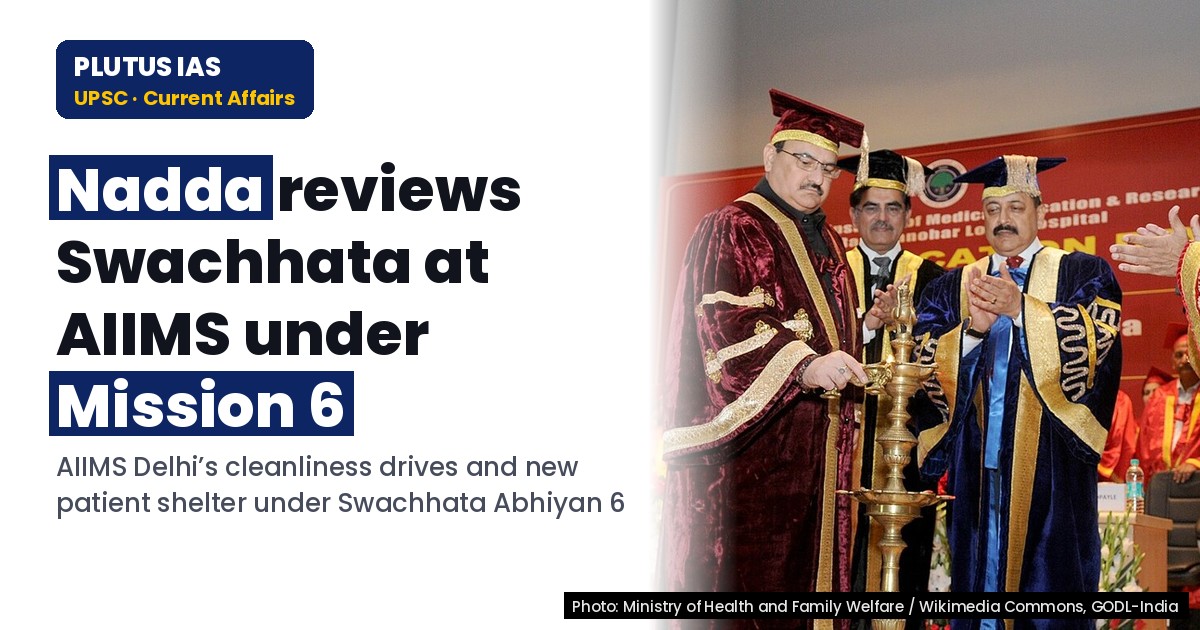
29 Oct Health Minister Reviews Swachhata Abhiyaan 6 at AIIMS New Delhi
✎ Swachhata Abhiyaan 6 at AIIMS Delhi integrates cleanliness, sustainability, and patient-centric infrastructure, including wastewater treatment, energy conservation, and EV mobility, while the ‘Aashray’ facility provides dignified…
Subject Relevance — Where This Topic Fits
- GS Paper II — Governance, Transparency and Accountability | GS Paper III — Environment and Sustainable Development | GS Paper III — Science and Technology
- Prelims: Swachh Bharat Mission, Swachhata Abhiyaan, AIIMS Delhi, Bharat Electronics Limited (BEL), Wastewater Treatment, Energy Conservation, Electric Vehicle Infrastructure, CSR (Corporate Social Responsibility), Hospital Waste Management
- Essay: Sustainable Development Goals and India’s Progress, Role of Public Institutions in Promoting Social Welfare
Quick Revision: Swachhata Abhiyaan 6 at AIIMS Delhi integrates cleanliness, sustainability, and patient-centric infrastructure, including wastewater treatment, energy conservation, and EV mobility, while the ‘Aashray’ facility provides dignified temporary accommodation for patients and attendants.
Why is this in the news?
The Union Health Minister, Shri Jagat Prakash Nadda, reviewed the cleanliness initiatives under Swachhata Abhiyaan 6 at AIIMS, New Delhi, and inspected the newly constructed ‘Aashray’ facility—a patient and attendant shelter developed under BEL’s CSR initiative. This development underscores the institutional commitment to sustainable healthcare infrastructure, hygiene, and patient-centric amenities in tertiary care facilities.
Background
- Swachhata Abhiyaan is a Government of India initiative launched to ensure cleanliness, hygiene, and sustainable practices across public institutions, including healthcare facilities.
- AIIMS, New Delhi, is a premier tertiary care and medical research public institution under the Ministry of Health and Family Welfare, serving as a model for healthcare delivery and infrastructure development.
- The ‘Aashray’ facility is part of AIIMS Delhi’s expansion to address the accommodation needs of patients and attendants, particularly those from economically weaker sections, ensuring dignified and weather-protected temporary stay.
- Bharat Electronics Limited (BEL), a Navratna PSU, has contributed to the project under its Corporate Social Responsibility (CSR) mandate, aligning with the government’s emphasis on public-private partnerships in healthcare infrastructure.
- Sustainable practices such as wastewater treatment, energy conservation, and electric mobility are increasingly integrated into healthcare infrastructure to reduce environmental impact and operational costs.
What is Swachhata Abhiyaan 6 and the ‘Aashray’ Facility at AIIMS Delhi?
- Special Campaign 6 (विशेष अभियान 6) is conducted under the Government of India’s cleanliness drive, focusing on institutionalising cleanliness, hygiene, and sustainable resource management in public institutions, including healthcare facilities.
- The campaign emphasises systematic waste management, regular cleaning schedules, staff training, and the use of mechanised cleaning equipment to enhance efficiency and hygiene standards.
- The ‘Aashray’ facility at AIIMS Delhi is a newly constructed patient and attendant shelter developed under BEL’s CSR initiative, designed to provide temporary, dignified, and weather-protected accommodation for 897 individuals.
- The facility spans 2,970 square meters and includes primary and secondary waiting areas, ramps, toilets, and auxiliary services to ensure accessibility and comfort for all users.
- AIIMS Delhi has adopted advanced cleanliness measures such as gang washing, dedicated cleaning staff for emergency and OPD toilets, post-OPD cleaning, and regular training for sanitation workers to maintain high hygiene standards.
- The institution has also implemented wastewater treatment plants with online monitoring and smart metering, enabling the reuse of approximately 19.6 lakh litres of treated wastewater daily for horticulture purposes.
- Energy conservation measures, including optimal air-conditioning usage and equipment shutdowns, have resulted in a 10.5% reduction in electricity consumption, saving approximately ₹1.98 crore between January and October 2025 compared to the same period in 2024.
- AIIMS Delhi promotes sustainable mobility by providing 40 free electric vehicle shuttles within the campus, supported by 30 EV chargers and 114 dedicated power points across four locations.
Key Features
| Feature | Significance |
|---|---|
| Gang washing systems | Ensures hygienic disposal of soiled linen and reduces cross-contamination risks in high-traffic areas. |
| Dedicated sanitation staff for emergency and OPD toilets | Maintains immediate cleanliness in critical patient-access areas. |
| End-of-day OPD cleaning protocols | Prevents accumulation of waste and reduces infection vectors during non-operational hours. |
| On-site wastewater treatment plants (11 units with smart metering) | Enables reuse of 19.6 lakh litres of treated water daily for horticulture, conserving potable water. |
| Electric vehicle shuttle services (40 units) | Promotes sustainable mobility within the campus for patients and attendants. |
Why it Matters
Public Health Governance
- Demonstrates institutional commitment to infection control through systematic sanitation and waste management in tertiary care settings.
- Highlights the integration of environmental sustainability with healthcare delivery, aligning with WHO’s ‘Healthy Hospitals’ guidelines.
Infrastructure and Service Delivery
- The ‘Ashray’ shelter exemplifies adaptive infrastructure for socio-economically vulnerable patients, reducing exposure to adverse weather and improving dignity.
- Smart monitoring systems in EV charging and waste management enhance operational transparency and accountability.
Resource Efficiency
- Energy conservation measures (7.68 lakh kWh reduction) and water reuse translate to cost savings of ₹1.98 crore (Jan-Oct 2025 vs. 2024), improving fiscal sustainability.
- Mechanised cleaning equipment and automated systems reduce dependency on manual labour, mitigating occupational health risks.
Challenges
1. Sustainable Waste Management
- High-volume biomedical waste generation in tertiary care requires continuous monitoring to prevent illegal dumping or incineration inefficiencies.
- Segregation compliance at source remains a challenge despite training, necessitating stricter audits and penalties.
UPSC Link: Environmental Pollution Control
2. Infrastructure Scalability
- Expansion of patient care areas (e.g., Trauma Centre) demands parallel scaling of sanitation and shelter facilities to avoid overcrowding.
- Retrofitting older structures with modern waste treatment systems is capital-intensive and logistically complex.
UPSC Link: Urban Infrastructure Development
3. Behavioural Compliance
- Ensuring consistent adherence to hygiene protocols among staff, patients, and attendants requires continuous awareness campaigns.
- Resistance to mechanised cleaning tools among traditional sanitation workers may hinder adoption without structured upskilling.
UPSC Link: Public Health Administration
Challenges — UPSC Perspective
| Issue | Concern |
|---|---|
| Biomedical waste segregation | Risk of non-compliance leading to environmental contamination and regulatory penalties. |
| Energy-intensive hospital operations | High carbon footprint despite conservation efforts; requires renewable energy integration. |
| Limited shelter capacity | Inadequate long-term solutions for homeless or migrant patients awaiting treatment. |
| Smart system dependency | Vulnerability to cyber threats or technical failures disrupting real-time monitoring. |
Way Forward
- Scale up on-site renewable energy projects (e.g., solar panels) to further reduce grid dependency and carbon emissions.
- Expand the ‘Ashray’ model to other AIIMS campuses and tertiary hospitals, with modular designs for scalability.
- Institute mandatory third-party audits of sanitation and waste management systems to ensure adherence to standards.
- Launch a nationwide training programme for sanitation staff, focusing on mechanised cleaning tools and safety protocols.
- Develop a digital dashboard for real-time tracking of energy, water, and waste metrics across all AIIMS campuses.
- Collaborate with CSR partners (e.g., BEL) to replicate the shelter model in public-private partnership (PPP) frameworks.
- Integrate climate-resilient design in new hospital constructions, including rainwater harvesting and passive cooling systems.
UPSC Value Addition
Keywords for Mains Answer-Writing
Swachh Bharat Mission · Special Campaign 6 · AIIMS Delhi sanitation initiatives · Waste management in healthcare · Sustainable healthcare infrastructure · Patient and attendant amenities · Energy and water conservation in hospitals · Corporate Social Responsibility (CSR) in healthcare · Hospital waste treatment plants · Electric vehicle mobility in healthcare campuses
Concept Flow
High patient load in tertiary care → Increased biomedical waste and sanitation demands → Need for systematic waste management. → Poor waste handling → Cross-infection risks and regulatory non-compliance → Implementation of gang washing and dedicated staff. → Energy-intensive hospital operations → High carbon footprint → Adoption of wastewater recycling and smart metering. → Vulnerable patient groups (e.g., homeless) → Lack of dignified shelter → Construction of ‘Ashray’ facilities. → Sustainability initiatives → Cost savings and operational efficiency → Reinvestment in healthcare infrastructure.
Prelims Practice Questions
Q1. Consider the following statements about Special Campaign 6 in healthcare institutions:
1. It is a centrally sponsored scheme aimed at improving cleanliness and hygiene in government hospitals.
2. The campaign mandates the use of manual cleaning methods exclusively to ensure authenticity.
3. It includes provisions for regular training of sanitation workers and timely payment of wages.
How many of the above statements are correct?
- Only one
- Only two
- All three
- None
Answer: Only two — Statement 1 is correct as Special Campaign 6 is a government initiative for cleanliness in public institutions. Statement 2 is incorrect because the campaign encourages mechanised cleaning tools and sustainable practices. Statement 3 is correct as regular training and timely wages for sanitation workers are part of the campaign’s guidelines.
Q2. Assertion (A): The AIIMS, New Delhi, has installed 11 wastewater treatment plants with online monitoring and smart metering.
Reason (R): The primary objective is to treat wastewater for reuse in gardening and reduce freshwater consumption.
In the context of the above two statements, which one of the following is correct?
- Both A and R are true, and R is the correct explanation of A
- Both A and R are true, but R is not the correct explanation of A
- A is true, but R is false
- A is false, but R is true
Answer: Both A and R are true, and R is the correct explanation of A — Assertion (A) is true as AIIMS Delhi has indeed installed 11 wastewater treatment plants with advanced monitoring systems. Reason (R) is also true and correctly explains the purpose of these plants, which is to treat wastewater for reuse in gardening and conserve freshwater resources.
Q3. Match the following initiatives of AIIMS, New Delhi, with their respective objectives:
Column I (Initiative) — Column II (Objective)
A. Gang washing — 1. Energy conservation
B. Smart surveillance system — 2. Wastewater management
C. Wastewater treatment plants — 3. Patient and attendant amenities
D. Electric vehicle shuttles — 4. Cleanliness and hygiene
Select the correct match:
- A-4, B-3, C-2, D-1
- A-4, B-1, C-2, D-3
- A-2, B-4, C-1, D-3
- A-1, B-2, C-3, D-4
Answer: A-4, B-1, C-2, D-3 — A. Gang washing (A-4) is a cleanliness and hygiene practice. B. Smart surveillance system (B-1) is used for energy conservation by optimising lighting and air-conditioning. C. Wastewater treatment plants (C-2) are for wastewater management. D. Electric vehicle shuttles (D-3) are for patient and attendant amenities.
Mains Practice Question
✍ The integration of sanitation, sustainability, and patient-centric amenities in healthcare infrastructure represents a paradigm shift in public health governance. Critically examine the significance of initiatives like Special Campaign 6 and the construction of facilities such as ‘Aashray’ at AIIMS, New Delhi, in achieving Sustainable Development Goals (SDGs) 3, 6, 7, and 11. (15 Marks)
Approach: MODEL-ANSWER SKELETON:
1. **Introduction**: Define SDGs 3 (Good Health and Well-being), 6 (Clean Water and Sanitation), 7 (Affordable and Clean Energy), and 11 (Sustainable Cities and Communities) and their relevance to healthcare infrastructure.
2. **Sanitation and Cleanliness (SDG 6)**: Discuss the role of Special Campaign 6 in improving hygiene, waste management, and cleanliness in AIIMS Delhi. Highlight the use of mechanised cleaning tools, regular training of sanitation workers, and waste segregation practices. Cite data on wastewater treatment and reuse (19.6 lakh litres daily).
3. **Sustainability (SDG 7)**: Explain energy conservation measures such as optimised air-conditioning, smart metering, and the reduction in electricity consumption (7.68 lakh kWh, 10.5% decrease). Mention the financial savings (₹1.98 crore) and the use of electric vehicle shuttles (40 vehicles) for sustainable mobility.
4. **Patient-Centric Amenities (SDG 3 and 11)**: Describe the ‘Aashray’ facility, its capacity (897 seats), and its role in providing safe, dignified, and weather-protected accommodation for patients and attendants. Link this to SDG 3 (reducing stress and improving health outcomes) and SDG 11 (inclusive and sustainable urban environments).
5. **Corporate Social Responsibility (CSR)**: Highlight the role of BEL, Ghaziabad, in constructing the ‘Aashray’ facility under CSR initiatives, demonstrating public-private partnerships in healthcare.
6. **Challenges and Way Forward**: Discuss potential challenges such as scalability of such initiatives, funding constraints, and the need for continuous monitoring. Suggest measures like expanding similar models to other healthcare institutions, leveraging technology for real-time monitoring, and ensuring equitable access to amenities.
7. **Conclusion**: Summarise the transformative impact of these initiatives on public health governance and their alignment with global sustainability goals.
Source: PIB (Press Information Bureau)
Generated by AanyaAi for educational purpose.
Related guides on our sites
- Best PSIR optional coaching in delhi
- Best PSIR optional coaching in delhi for UPSC
- Anthropology VS PSIR
- Best PSIR optional coaching online

- PM inaugurates CCIC Pavilion at Bharat Parv 2026 in Kevadia - October 31, 2026
- ग्राम पंचायतों में ईवी चार्जिंग और बैटरी स्वैपिंग स्टेशन: सीईएसएल की पहल - October 31, 2026
- El Niño Threatens Wayanad: Crop Loss, Water Crisis & Health Risks - October 31, 2026

No Comments