


01 Sep Himachal Assembly Rejects Regularization of 414 AIDS Control Workers & ASHA Staff Policy
✎ Contractual health workers in India, including those under NACP and ASHAs, lack automatic entitlement to regularisation; employment security depends on state-specific policies and programme guidelines.
Subject Relevance — Where This Topic Fits
- GS Paper II — Governance, Transparency and Accountability | GS Paper III — Human Resource Development
- Prelims: Contractual workforce in health sector, Regularisation of contractual employees, ASHA workers, National AIDS Control Programme, National Health Mission
- Essay: Role of contractual workforce in public service delivery, Policy coherence in health sector employment
Quick Revision: Contractual health workers in India, including those under NACP and ASHAs, lack automatic entitlement to regularisation; employment security depends on state-specific policies and programme guidelines.
Why is this in the news?
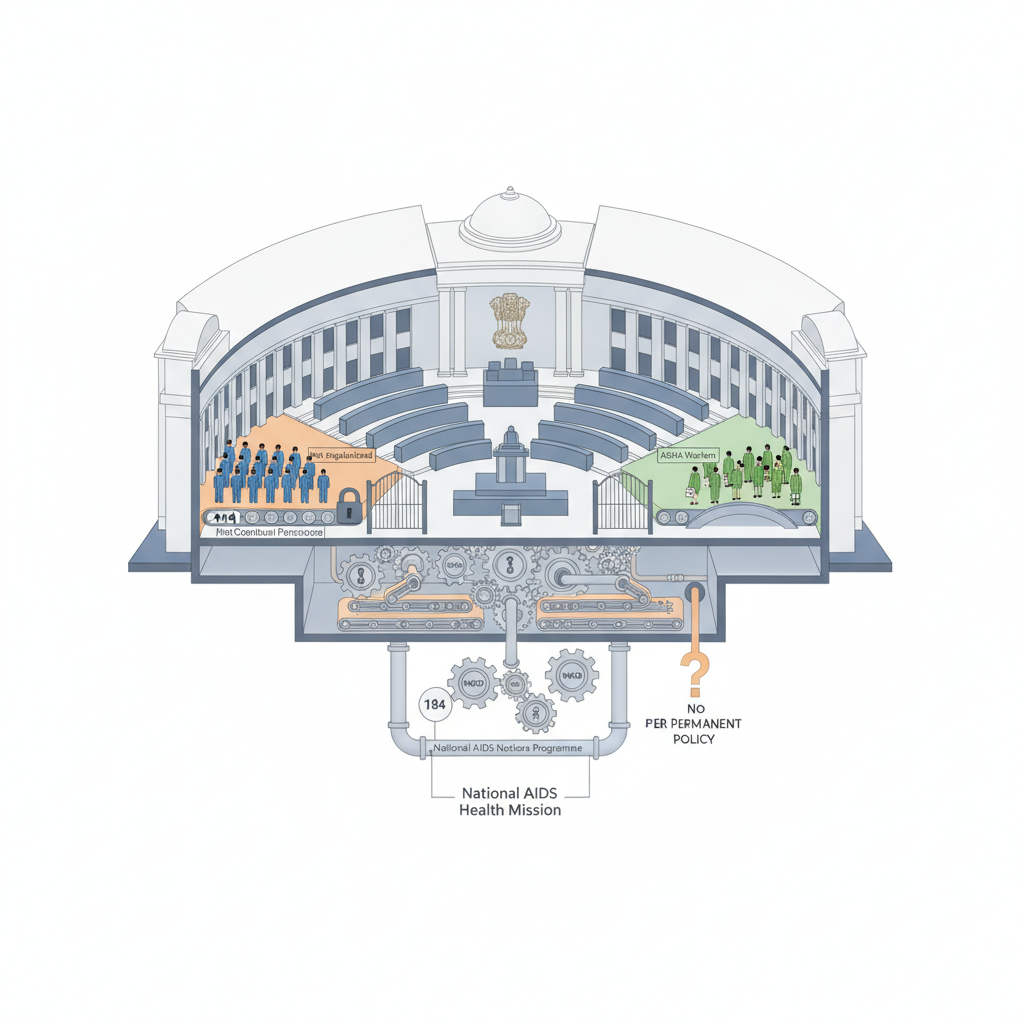
The Himachal Pradesh Legislative Assembly has clarified that 414 contractual employees engaged under the AIDS Control Programme through 18 NGOs will not be regularised, and no permanent policy exists for ASHA workers. This decision, communicated via written replies to legislative queries, highlights systemic gaps in employment security for health workers engaged under non-governmental or mission-based frameworks.
Background
- The National AIDS Control Programme (NACP) in India operates through a public-private partnership model, engaging NGOs and contractual staff for targeted interventions.
- ASHA (Accredited Social Health Activist) workers are community-based frontline health workers under the National Health Mission (NHM), engaged on a performance-based incentive model.
- Himachal Pradesh has 18 NGOs registered under the AIDS Control Programme, employing 414 contractual staff for outreach, testing, and awareness activities.
- The state government has not proposed regularisation of these contractual workers, citing the absence of a formal cadre or policy framework.
- ASHA workers in Himachal Pradesh are remunerated through a combination of central government incentives and state honoraria, with no provision for permanent absorption.
- The clarification follows legislative queries on the employment status and future policy direction for these health workers.
What are the contractual health workforce frameworks in India?
- National AIDS Control Programme (NACP): Launched in 1992, NACP operates through NGOs and contractual staff for HIV prevention, testing, and care services under the Ministry of Health and Family Welfare.
- ASHA Workers: Part of the National Health Mission (NHM), ASHAs are community health volunteers for primary healthcare delivery.
- Contractual Employment: Health workers under NACP and ASHAs are typically engaged on short-term contracts or performance-based incentives, with no automatic entitlement to regularisation.
- Policy Framework: Regularisation of contractual health workers is governed by state-specific policies, central guidelines, and Supreme Court rulings on service conditions and social security.
- Governance Challenges: The absence of a permanent cadre for such workers creates employment insecurity, affecting service continuity and worker motivation.
- Legal Precedents: The Supreme Court has in some cases directed regularisation of contractual employees engaged in perennial nature of work, though exceptions apply based on policy and functional requirements.
- Alternative Models: Some states have explored cadre creation or absorption of ASHAs into health departments, but Himachal Pradesh has not adopted such a policy.
Key Features
| Feature | Significance |
|---|---|
| Temporary contractual workforce in AIDS control | Ensures service delivery through NGOs under annual contracts but lacks job security, impacting long-term institutional capacity. |
| ASHA workers’ contractual status | Maintains a performance-based incentive model aligned with National Health Mission (NHM) norms, avoiding permanent cadre creation. |
| Lack of regularisation policy | Reflects a governance choice prioritising flexibility and budgetary control over workforce stability in public health programmes. |
| NGO-mediated service delivery | Demonstrates a public-private partnership model for health interventions, relying on specialised agencies for targeted outreach. |
| State-level policy vacuum | Highlights the absence of a formal framework for workforce regularisation, leaving workers in a precarious employment status. |
Why it Matters
Public Health Governance
- The reliance on contractual workers for AIDS control underscores the role of NGOs in India’s public health architecture, particularly for stigma-sensitive programmes like HIV/AIDS.
Fiscal Implications
- Avoiding regularisation reduces recurring expenditure on salaries and benefits, aligning with fiscal prudence but potentially at the cost of worker retention and service quality.
Workforce Management Challenges
- The absence of a permanent cadre for ASHA workers and AIDS control staff reflects systemic gaps in human resource planning for community health programmes.
Policy Coherence
- The decision reflects a policy preference for performance-linked incentives over job security, consistent with NHM’s design but raising questions about worker motivation and service continuity.
Challenges
1. Workforce Instability in Public Health
- High turnover of contractual workers may disrupt continuity in AIDS control programmes, particularly in prevention, testing, and counselling services.
- Lack of regularisation limits career progression, potentially reducing the attractiveness of such roles for skilled professionals.
- ASHA workers’ contractual status may affect their ability to advocate effectively within communities due to perceived job insecurity.
UPSC Link: GS-II: Health Governance
2. Policy Fragmentation in Health Programmes
- The absence of a unified policy for regularisation across health cadres creates inconsistencies in workforce management and service delivery.
- State-level decisions on workforce regularisation may lead to disparities in health service quality and accessibility across regions.
UPSC Link: GS-II: Health Sector Reforms
3. NGO-Dependent Service Delivery
- Over-reliance on NGOs for AIDS control may lead to variability in service quality, monitoring, and accountability.
- Contractual arrangements with NGOs may not always align with public health priorities, especially in long-term prevention and awareness campaigns.
UPSC Link: GS-II: Public-Private Partnerships
4. Budgetary Constraints vs. Service Quality
- While contractual arrangements reduce immediate costs, they may incur hidden expenses such as frequent retraining and recruitment due to high turnover.
- The lack of a permanent workforce may hinder the scalability of health programmes during public health emergencies.
UPSC Link: GS-III: Fiscal Federalism
Challenges — UPSC Perspective
| Issue | Concern |
|---|---|
| Job insecurity for contractual workers | Potential decline in service quality and worker motivation due to lack of career stability. |
| Policy vacuum for workforce regularisation | Creates uncertainty and inequities in employment conditions across health cadres. |
| NGO-mediated service delivery | Risk of variability in programme implementation and accountability mechanisms. |
| Performance-based incentives for ASHA workers | May not adequately compensate for the lack of job security or career growth. |
| State-level discretion in workforce policies | Could lead to regional disparities in health service delivery and workforce management. |
Way Forward
- Develop a state-specific policy framework for workforce regularisation in public health programmes, balancing fiscal constraints with service continuity.
- Strengthen monitoring and evaluation mechanisms for NGOs engaged in AIDS control to ensure accountability and service quality.
- Explore hybrid models of employment (e.g., fixed-term contracts with benefits) to retain skilled workers while maintaining budgetary discipline.
- Conduct periodic reviews of ASHA workers’ remuneration to ensure it reflects the scope of work and inflation, without compromising the incentive-based model.
- Promote skill upgradation and certification programmes for contractual workers to enhance their employability and career prospects.
- Enhance data systems to track workforce trends, turnover rates, and service delivery gaps in public health programmes.
- Align state policies with national guidelines on workforce management in health to ensure coherence and reduce disparities.
UPSC Value Addition
Keywords for Mains Answer-Writing
ASHA workers · contractual workforce in public health · regularisation of contractual employees · National Health Mission · AIDS control programme · public health governance · health sector reforms · service conditions of frontline workers · National AIDS Control Programme · health workforce policy · voluntary sector in health delivery · performance-based incentives
Concept Flow
Contractual workforce in AIDS control and ASHA programmes → Policy decision on regularisation → Impact on service delivery and workforce stability → Fiscal implications and governance choices → Broader challenges in public health workforce management → Need for policy reforms and accountability mechanisms
Prelims Practice Questions
Q1. Consider the following statements regarding ASHA workers in India:
1. ASHA workers are engaged under the National Health Mission and are classified as voluntary workers.
2. They receive performance-based incentives in addition to a fixed honorarium.
3. The Union Government provides 100% funding for their honoraria and incentives.
4. ASHA workers are entitled to regularisation under the National Health Mission’s service conditions.
How many of the above statements are correct?
- Only one
- Only two
- Only three
- All four
Answer: Only three — Statements 1 and 2 are correct as ASHAs are voluntary workers under NHM receiving performance-based incentives. Statement 3 is incorrect as funding is shared between the Centre and States. Statement 4 is incorrect as ASHAs are not entitled to regularisation under NHM norms.
Q2. Assertion (A): The National AIDS Control Programme (NACP) in India is implemented through a mix of government and non-governmental organisations.
Reason (R): The NACP relies on contractual workers engaged by NGOs for service delivery, as these workers are not regular government employees.
In the context of the above two statements, which one of the following is correct?
- Both A and R are true, and R is the correct explanation of A.
- Both A and R are true, but R is not the correct explanation of A.
- A is true, but R is false.
- A is false, but R is true.
Answer: Both A and R are true, but R is not the correct explanation of A. — Assertion (A) is true as NACP is implemented through both government and non-governmental organisations. Reason (R) correctly explains this by stating that contractual workers engaged by NGOs are a key component of service delivery under NACP.
Q3. Which of the following best describes the current service conditions of ASHA workers in India?
- Permanent government employees with defined service benefits
- Contractual workers engaged under the National Health Mission with performance-based incentives
- Voluntary workers receiving fixed monthly salaries from the state government
- Temporary employees eligible for regularisation after five years of service
Answer: Contractual workers engaged under the National Health Mission with performance-based incentives — ASHA workers are contractual workers engaged under the National Health Mission and receive performance-based incentives rather than fixed salaries or permanent positions.
Mains Practice Question
✍ The contractualisation of frontline health workers such as ASHA workers and AIDS control programme staff has emerged as a structural feature of India’s public health governance. Critically examine the implications of this model for service delivery, worker welfare, and the achievement of universal health coverage. Substantiate your answer with reference to constitutional provisions, policy frameworks, and judicial observations. (15 Marks)
Approach: MODEL-ANSWER SKELETON:
1. **Context and Constitutional Framework** (3 points):
– Article 21 (Right to Health) and Article 41 (Directive Principle of State Policy) as foundational rights.
– State obligation under Article 47 to improve public health.
– Judicial recognition of health as a fundamental right (e.g., Paschim Banga Khet Mazdoor Samity v. State of West Bengal, 1996).
2. **Policy Framework and Contractualisation** (4 points):
– National Health Mission (NHM) and its reliance on ASHA workers as voluntary workers.
– National AIDS Control Programme (NACP) Phase V (2021-2026) and its engagement of contractual workers through NGOs.
– Performance-based incentives under NHM and their impact on worker motivation and accountability.
– Contrast with regular government employees: service conditions, social security, and career progression.
3. **Implications for Service Delivery** (3 points):
– Advantages: flexibility, community connect, and cost-effectiveness in reaching marginalised populations.
– Challenges: high attrition, lack of job security, and compromised quality of care due to inadequate training and support.
– Case study: Himachal Pradesh’s decision to not regularise 414 AIDS control workers and its impact on programme continuity.
4. **Worker Welfare and Social Justice** (3 points):
– Violation of labour rights under Article 23 (prohibition of human trafficking) and Article 24 (prohibition of child labour) as contractual workers lack basic protections.
– Lack of social security benefits (provident fund, gratuity, health insurance) for contractual workers.
– Judicial observations: Supreme Court’s stance on the regularisation of contractual employees (e.g., Secretary, State of Karnataka v. Uma Maheswari, 2011).
5. **Universal Health Coverage (UHC) and Equity** (2 points):
– Contractualisation may undermine UHC by creating a two-tier health workforce with unequal access to resources and opportunities.
– Impact on marginalised communities: reduced trust in public health systems due to high turnover and inconsistent service quality.
6. **Way Forward** (2 points):
– Strengthening contractual workers’ rights through legislative reforms (e.g., Code on Social Security, 2020).
– Gradual regularisation of frontline workers where feasible, with adequate budgetary provisions.
– Enhancing training, supervision, and career progression pathways for contractual workers.
Source: amarujala.com
Himachal Pradesh PCS (HPPSC (HAS)) — State PCS Practice
Prelims: As per the recent Himachal Pradesh Legislative Assembly discussions, which of the following statements is correct regarding the appointment of ASHA workers and 414 Aids Control personnel?
- A. Both ASHA workers and 414 Aids Control personnel will be granted permanent positions in the state.
- B. Neither ASHA workers nor 414 Aids Control personnel will be granted permanent positions; their appointments will remain contractual.
- C. Only ASHA workers will be granted permanent positions, while 414 Aids Control personnel will remain contractual.
- D. Only 414 Aids Control personnel will be granted permanent positions, while ASHA workers will remain contractual.
Answer: B. Neither ASHA workers nor 414 Aids Control personnel will be granted permanent positions; their appointments will remain contractual. — The Himachal Pradesh Legislative Assembly has clarified that neither ASHA workers nor 414 Aids Control personnel will be granted permanent positions, and their appointments will continue on a contractual basis.
Mains: Discuss the implications of the Himachal Pradesh Legislative Assembly’s decision to not grant permanent positions to ASHA workers and 414 Aids Control personnel. Highlight the challenges this poses for healthcare delivery in the state and suggest measures to address these concerns.
Generated by AanyaAi for educational purpose.
Related guides on our sites
- Current affairs for upsc 2026
- Best PSIR optional coaching for upsc
- Best PSIR optional teacher for upsc
- Best teacher of PSIR optional for upsc

- उत्तराखंड राज्यपाल की पीएम मोदी से महत्वपूर्ण बैठक: जानिए मुख्य बिंदु - October 23, 2026
- How India’s Rs 20,000 Cr CCUS Budget Can Drive Net-Zero Goals - October 23, 2026
- पंजाब-हरियाणा में पराली जलाने पर सीएक्यूएम की सख्त समीक्षा, तुरंत उठाये गये कदमों पर जोर - October 23, 2026

No Comments