


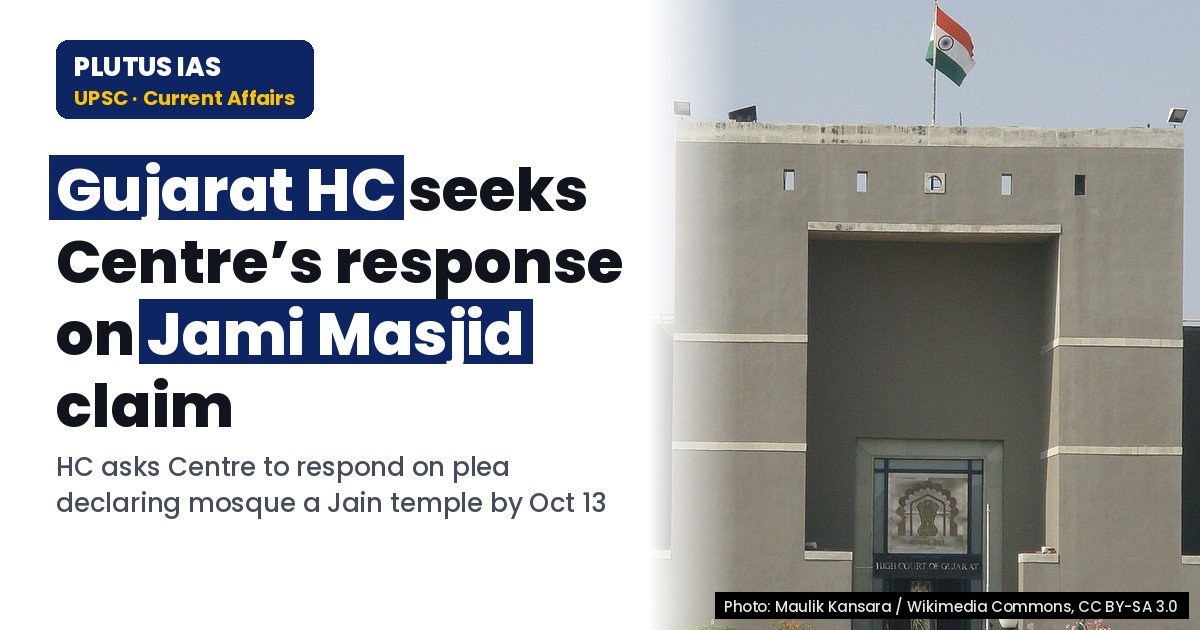
10 Oct Is Gujarat’s Jami Masjid a Jain Temple? HC Asks Centre to Respond
✎ The Ancient Monuments and Archaeological Sites and Remains Act, 1958, empowers the ASI to protect and preserve monuments of national importance, while judicial review under Article 226 ensures accountability in disputes involving…
Subject Relevance — Where This Topic Fits
- GS Paper II — Polity and Governance (Constitutional Provisions, Judicial Review, Fundamental Rights) | GS Paper II — Governance (Protection of Cultural Heritage, Statutory Bodies)
- Prelims: Ancient Monuments and Archaeological Sites and Remains Act, 1958, Archaeological Survey of India (ASI), Fundamental Rights (Articles 25, 26, 29, 30), Gazette Notification of Protected Monuments, Judicial Review, Writ Jurisdiction (Article 226)
- Essay: The interplay between religious freedom and cultural heritage preservation in a pluralistic society, The role of judicial intervention in safeguarding historical monuments
Quick Revision: The Ancient Monuments and Archaeological Sites and Remains Act, 1958, empowers the ASI to protect and preserve monuments of national importance, while judicial review under Article 226 ensures accountability in disputes involving their conservation and interpretation.
Why is this in the news?
The Gujarat High Court’s directive to the Union Government and central authorities to respond to a petition seeking a declaration that Bharuch’s historic Jami Masjid is a Jain temple underscores the intersection of religious identity, archaeological preservation, and statutory obligations under the Ancient Monuments and Archaeological Sites and Remains Act, 1958. The case highlights the legal and administrative challenges in determining the historical and religious character of protected monuments and the role of judicial oversight in such disputes.
Background
- The Archaeological Survey of India (ASI) has expressed concerns about potential damage to the structure and communal harmony, citing social media campaigns and public gatherings advocating for the reclassification of the mosque as a Jain temple.
- A right-wing organisation, Rashtriya Dharohar Sanrakshan Samiti, has been actively campaigning since May to reclaim the monument as a Jain religious site, alleging historical misrepresentation in ASI records.
- The petitioners, claiming affiliation with the ‘Jain Hindu community,’ have submitted photographs and a video purporting to show an idol of Tirthankar Mallinath within the monument, seeking interim protection under Article 226 of the Constitution.
- The ASI has maintained that the monument is being preserved strictly in accordance with the law, while the High Court has noted that the petitioners approached the court without exhausting administrative remedies.
- The dispute raises questions about the legal framework governing the protection of historical monuments and the balance between religious freedom, cultural heritage, and statutory obligations.
Legal and Archaeological Framework Governing Protected Monuments in India
- The Ancient Monuments and Archaeological Sites and Remains Act, 1958, provides the statutory framework for the preservation and protection of monuments of national importance, vesting authority in the ASI for their maintenance and conservation.
- Protected monuments are notified by the Central Government through gazette notifications, as in the case of the Jami Masjid in Bharuch, which has been under ASI protection since 1909.
- The Act empowers the ASI to take measures to prevent damage to monuments, including the removal of unauthorised structures or activities that threaten their integrity.
- Judicial review under Article 226 of the Constitution enables the High Courts to issue writs for the enforcement of fundamental rights, including the right to cultural preservation and protection of religious sites.
- The determination of a monument’s religious or historical character is a complex process involving archaeological evidence, historical records, and legal interpretations, often requiring expert testimony.
- The ASI’s records, including those maintained since colonial times, serve as primary evidence in such disputes, though they may be subject to reinterpretation based on new findings or claims.
- The case underscores the constitutional balance between the right to freedom of religion (Article 25) and the right to conserve cultural heritage (Article 49), as well as the state’s duty to protect monuments under Article 51A(f).
Key Features
| Feature | Significance |
|---|---|
| Protected Monument Status | The Jami Masjid in Bharuch is designated as a ‘Monument of National Importance’ under the Ancient Monuments and Archaeological Sites and Remains Act, 1958, affording it legal protection against alteration or damage. |
| ASI Custodianship | The Archaeological Survey of India (ASI) is statutorily obligated under Section 16 of the AMASR Act, 1958, to preserve and maintain protected monuments, including their artefacts and structures. |
| Historical Records Dispute | The petition challenges the ASI’s recorded classification of the structure as a mosque, asserting it is a Jain temple, thereby invoking questions of historical documentation and archaeological interpretation. |
| Idol Preservation | The petitioners allege damage to an idol of Tirthankar Mallinath, raising concerns about the conservation of religious artefacts within protected monuments under the AMASR Act. |
| Judicial Intervention | The Gujarat High Court’s suo motu observation of the ASI’s statutory duty highlights the judiciary’s role in ensuring compliance with heritage protection laws. |
Why it Matters
Legal and Administrative
- The case underscores the legal framework governing protected monuments, particularly the AMASR Act, 1958, and the obligations of the ASI in preserving cultural heritage.
- The dispute tests the balance between religious claims and statutory protection, requiring judicial interpretation of historical records and archaeological evidence.
- The High Court’s directive to the Centre to respond reflects the intersection of governance, heritage management, and judicial oversight in resolving heritage disputes.
Cultural Heritage
- The Jami Masjid’s status as a protected monument highlights the importance of safeguarding India’s pluralistic architectural and religious heritage.
- The case raises questions about the authenticity of historical records and the methodologies used by the ASI in classifying monuments.
- It exemplifies the challenges in reconciling competing historical narratives while adhering to legal protections for cultural assets.
Public Order and Social Harmony
- The ASI’s warning about potential communal tensions underscores the need for preventive measures to avoid incidents that could disrupt social cohesion.
- The case demonstrates how heritage disputes can escalate into broader societal issues, necessitating sensitive handling by authorities.
Challenges
1. Legal Ambiguity in Monument Classification
- Disputes over the historical classification of monuments create legal uncertainty, complicating the ASI’s custodianship role.
- The case highlights the need for clear guidelines on interpreting historical records and resolving competing claims.
- Judicial intervention may set a precedent for future disputes, influencing how similar cases are adjudicated.
UPSC Link: GS Paper 1: Indian Heritage and Culture
2. Preservation vs. Religious Claims
- Balancing the preservation of protected monuments with competing religious claims poses a significant governance challenge.
- The ASI’s role as custodian requires it to navigate such disputes impartially, adhering to legal and archaeological standards.
- Failure to address such disputes promptly can lead to damage to heritage sites and social unrest.
UPSC Link: GS Paper 1: Indian Heritage and Culture
3. Preventive Measures for Heritage Sites
- The ASI’s proactive warnings about potential damage reflect the importance of preventive measures in heritage conservation.
- Coordinating with local authorities to mitigate risks, such as public gatherings or protests, is essential to safeguarding monuments.
- The case underscores the need for robust monitoring and enforcement mechanisms to protect heritage sites.
UPSC Link: GS Paper 2: Governance and Administration
4. Judicial Role in Heritage Disputes
- The Gujarat High Court’s intervention highlights the judiciary’s role in resolving disputes involving protected monuments.
- Judicial decisions in such cases can set precedents for future disputes, influencing heritage governance and legal frameworks.
- The court’s emphasis on the ASI’s statutory obligations reinforces the importance of legal compliance in heritage management.
UPSC Link: GS Paper 2: Judiciary and Constitutional Framework
5. Public Awareness and Misinformation
- Campaigns and social media narratives can exacerbate heritage disputes, leading to misinformation and heightened tensions.
- Educating the public about the legal protections for monuments and the importance of heritage conservation is critical.
- Authorities must address misinformation proactively to prevent escalation of disputes.
UPSC Link: GS Paper 4: Ethics and Integrity
Challenges — UPSC Perspective
| Issue | Concern |
|---|---|
| Historical Classification Disputes | Competing narratives about the monument’s origin create legal and administrative challenges in determining its true status. |
| Preservation of Religious Artefacts | Ensuring the conservation of artefacts within protected monuments while respecting religious sentiments requires careful handling. |
| Preventing Communal Tensions | Heritage disputes can escalate into broader societal issues, necessitating preventive measures to maintain social harmony. |
| Judicial Precedents | The case may set a legal precedent for future heritage disputes, influencing how such cases are adjudicated. |
| Public Misinformation | Social media and campaigns can fuel misinformation, complicating efforts to resolve disputes peacefully. |
| Coordination Among Authorities | Effective collaboration between the ASI, judiciary, and local administration is essential to address disputes promptly and impartially. |
Way Forward
- The ASI should conduct a thorough archaeological survey and historical reappraisal of the monument to clarify its origins and ensure accurate documentation.
- The Gujarat High Court may direct the formation of an expert committee comprising historians, archaeologists, and representatives from relevant religious communities to assess the monument’s status.
- Local and state authorities should enhance monitoring of the monument to prevent unauthorized activities or damage, in coordination with the ASI.
- Public awareness campaigns should be launched to educate communities about the legal protections for heritage sites and the importance of preserving cultural assets.
- The Centre and state governments should consider amending the AMASR Act, 1958, to include clearer guidelines for resolving disputes over monument classification.
- Judicial training programs on heritage law and archaeological practices could be introduced to equip judges with the expertise needed to adjudicate such cases.
- Mechanisms for community engagement should be established to address grievances and foster dialogue among stakeholders involved in heritage disputes.
UPSC Value Addition
Keywords for Mains Answer-Writing
Ancient Monuments and Archaeological Sites and Remains Act, 1958 · Archaeological Survey of India (ASI) · Monuments of National Importance · Protection of historical monuments · Religious and cultural heritage preservation · Constitutional provisions for religious sites · Gujarat High Court · Judicial review of heritage disputes · Right to worship vs. heritage conservation · Secularism and cultural pluralism in India
Constitutional & Policy Linkages
- [‘Article 49: Protection of monuments and places of national importance.’]
- [‘Article 51A(f): Fundamental duty to value and preserve the rich heritage of our composite culture.’]
Concept Flow
Historical narratives and religious claims regarding the Jami Masjid’s origins → Petition filed in Gujarat High Court challenging ASI’s classification of the monument → ASI’s statutory obligation to preserve protected monuments under AMASR Act, 1958 → High Court’s directive to Centre and ASI to respond, highlighting judicial oversight → Potential expert committee formation for historical reappraisal and assessment → Implementation of preventive measures to safeguard the monument and artefacts → Judicial decision setting a precedent for future heritage disputes
Prelims Practice Questions
Q1. Consider the following statements regarding the Ancient Monuments and Archaeological Sites and Remains Act, 1958:
1. It provides for the preservation of monuments and sites declared as of national importance.
2. The Act empowers the Central Government to prohibit construction in the protected area around a monument.
3. The ASI is mandated under this Act to maintain and protect only those monuments that are under its direct ownership.
How many of the above statements are correct?
- Only one
- Only two
- All three
- None
Answer: Only two — Statements 1 and 2 are correct under Sections 3 and 20 of the Act. Statement 3 is incorrect as the ASI is responsible for protecting all protected monuments, regardless of ownership.
Q2. Assertion (A): The Archaeological Survey of India (ASI) is the sole authority responsible for the protection and preservation of all historical monuments in India.
Reason (R): The Ancient Monuments and Archaeological Sites and Remains Act, 1958, vests the ASI with exclusive powers to declare and protect monuments of national importance.
Options:
A. Both A and R are true, and R is the correct explanation of A.
B. Both A and R are true, but R is not the correct explanation of A.
C. A is true, but R is false.
D. A is false, but R is true.
- A
- B
- C
- D
Answer: D — The ASI is the primary authority but not the sole one; state governments and local bodies also share responsibility under the Act. The Act does not vest exclusive powers solely in the ASI.
Q3. Match the following pairs related to heritage conservation in India:
Column I
1. Ancient Monuments and Archaeological Sites and Remains Act, 1958
2. Monuments of National Importance
3. ASI’s role in heritage protection
4. Right to worship vs. heritage conservation
Column II
A. Declared by gazette notification
B. Balancing religious rights and preservation
C. Legal framework for preservation
D. Statutory body for conservation
Select the correct match:
- 1-C, 2-A, 3-D, 4-B
- 1-A, 2-C, 3-B, 4-D
- 1-D, 2-B, 3-A, 4-C
- 1-B, 2-D, 3-C, 4-A
Answer: 1-C, 2-A, 3-D, 4-B — 1 matches with C (legal framework), 2 with A (declared by gazette), 3 with D (ASI’s role), and 4 with B (balancing rights and conservation).
Mains Practice Question
✍ The preservation of historical monuments in India often involves balancing the right to worship with the imperative of heritage conservation. In this context, critically examine the role of the Archaeological Survey of India (ASI) and the legal framework governing the protection of monuments of national importance. Also, discuss the challenges posed by disputes over the historical identity of monuments, citing the Bharuch Jami Masjid case as an illustration. (15 Marks)
Approach: MODEL-ANSWER SKELETON:
1. **Legal Framework**:
– Ancient Monuments and Archaeological Sites and Remains Act, 1958: Key provisions (Sections 3, 20, 21) governing declaration, protection, and prohibited activities.
– Monuments of National Importance: Definition and gazette notification process (e.g., Bharuch Jami Masjid declared in 1909).
– ASI’s statutory obligations: Maintenance, preservation, and restoration under Section 6.
2. **Balancing Rights**:
– Right to worship (Article 25 of the Constitution) vs. heritage conservation (Article 49: duty to protect monuments).
– Judicial precedents: Madhya Pradesh High Court judgment cited in the Bharuch case; Supreme Court rulings on balancing religious rights and preservation (e.g., Ismail Faruqui case, 1994).
3. **Challenges in Heritage Disputes**:
– **Historical Identity**: Disputes over the original identity of monuments (e.g., Bharuch Jami Masjid as a Jain temple).
– **Evidentiary Burden**: Reliance on historical records, ASI surveys, and archaeological evidence.
– **Social Harmony**: Risk of communal tensions and damage to monuments (ASI’s warning in Bharuch case).
4. **Case Illustration – Bharuch Jami Masjid**:
– ASI’s role: Maintenance under the Act; statutory obligation to preserve the structure and artefacts.
– Petitioners’ claims: Allegations of damage to artefacts and idols; reliance on historical background.
– Judicial intervention: Gujarat High Court’s directive to the Centre and ASI to respond; interim protection granted.
5. **Way Forward**:
– Strengthening ASI’s enforcement mechanisms.
– Promoting interdisciplinary research (history, archaeology, epigraphy) to resolve disputes.
– Public awareness campaigns to foster respect for heritage conservation.
6. **Conclusion**:
– Reiterate the need for a balanced approach that upholds both constitutional rights and heritage preservation, with the ASI as the guardian of India’s cultural legacy.
Source: The Indian Express
Gujarat PCS (GPSC) — State PCS Practice
Prelims: Consider the following statements regarding the recent Gujarat High Court directive on Bharuch’s Jami Masjid: 1. The Gujarat High Court has sought the Centre’s response on whether Bharuch’s Jami Masjid was originally a Jain temple. 2. The directive was issued in response to a petition challenging the mosque’s current status. 3. The Archaeological Survey of India (ASI) has not yet submitted a report on the matter. Which of the above statements are correct?
- 1 and 2 only
- 2 and 3 only
- 1 and 3 only
- 1, 2, and 3
Answer: 1 and 2 only — Statements 1 and 2 are correct as per the reported directive. Statement 3 cannot be verified from the given topic.
Mains: Examine the historical and cultural significance of Bharuch’s Jami Masjid in the context of Gujarat’s pluralistic heritage. How should the state government balance the preservation of religious sites with the need for historical clarity and public interest? (250 words)
Generated by AanyaAi for educational purpose.
Related guides on our sites
- Anthropology VS PSIR
- Best PSIR optional coaching
- Best PSIR optional coaching online
- Sociology vs History

- विशाखापट्टनम में उच्च जोखिम गर्भावस्था की निगरानी बढ़ाने पर कलेक्टर का निर्देश, जानिए पूरी जानकारी - October 21, 2026
- National Unity Day 2026: Key Preparations & Significance for UPSC - October 21, 2026
- 14वां इंडिया केम 2026: मुंबई में वैश्विक रसायन उद्योग का महाकुंभ - October 21, 2026

No Comments