


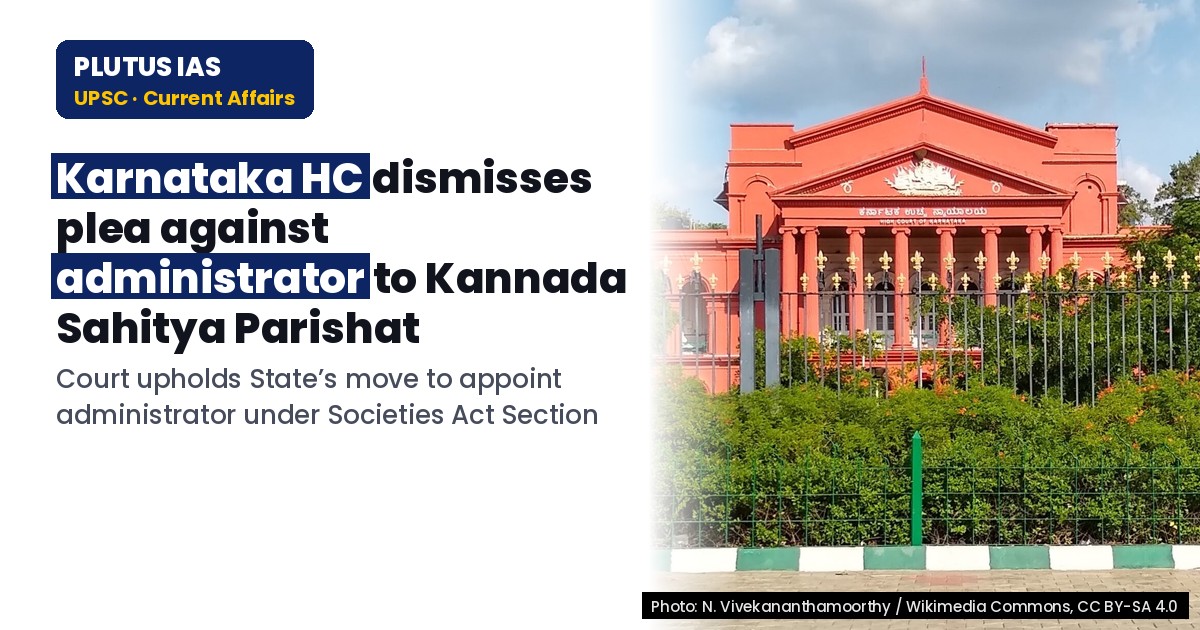
06 Oct Karnataka HC upholds administrator appointment to Kannada Sahitya Parishat
✎ Administrative intervention in registered societies under Section 27 of the Karnataka Societies Registration Act, 1960, must be grounded in statutory provisions and is subject to judicial review, ensuring checks and balances in…
Subject Relevance — Where This Topic Fits
- GS Paper II — Constitutional and Non-Constitutional Bodies | GS Paper III — Government Policies and Interventions for Development in various sectors
- Prelims: Societies Registration Act, 1960, Administrative intervention in societies, Judicial review of administrative actions, Karnataka High Court, Section 27 of Karnataka Societies Registration Act, 1960
- Essay: Judicial activism vs. administrative discretion in governance, Role of courts in ensuring accountability in public institutions
Quick Revision: Administrative intervention in registered societies under Section 27 of the Karnataka Societies Registration Act, 1960, must be grounded in statutory provisions and is subject to judicial review, ensuring checks and balances in governance.
Why is this in the news?
The Karnataka High Court’s dismissal of a petition challenging the state government’s appointment of an administrator to the Kannada Sahitya Parishat underscores the legal framework governing administrative interventions in registered societies. The verdict reaffirms the primacy of statutory provisions while leaving substantive issues of financial mismanagement and governance open for adjudication, highlighting the delicate balance between administrative authority and judicial oversight in societal governance.
Background
- The Kannada Sahitya Parishat is a registered society under the Karnataka Societies Registration Act, 1960, established to promote Kannada language and literature.
- In September 2025, the Karnataka government appointed an administrator to the Parishat, citing allegations of financial mismanagement and non-cooperation with a government inquiry.
- The petitioner, Mahesh Joshi, former president of the Parishat, challenged the appointment, arguing it was arbitrary and lacked legal justification.
- The High Court’s order dismissed the petition while clarifying that the administrator’s continuance is subject to compliance with Section 27 of the Karnataka Societies Registration Act, 1960.
- The court explicitly stated that its order does not validate the findings of the inquiry or the government’s actions, leaving these issues to be decided separately under the law.
What is the Karnataka Societies Registration Act, 1960?
- The Karnataka Societies Registration Act, 1960, is a state legislation that governs the registration, administration, and dissolution of societies in Karnataka.
- It provides a legal framework for the formation of societies for literary, scientific, or charitable purposes, including cultural institutions like the Kannada Sahitya Parishat.
- The section ensures that administrative interventions are temporary and subject to judicial review, balancing governance needs with legal safeguards.
- The Act mandates that such interventions must be justified by recorded reasons and comply with the provisions of the Act, preventing arbitrary or prolonged interference.
- Registered societies under the Act are distinct from statutory bodies and derive their authority from the Act, making them subject to state oversight in matters of governance.
- The Act also provides for the dissolution of a society if its affairs cannot be managed satisfactorily, ensuring accountability and transparency.
Key Features
| Feature | Significance |
|---|---|
| Appointment of Administrator | The State government’s decision to appoint an administrator to the Kannada Sahitya Parishat under Section 27 of the Karnataka Societies Registration Act, 1960, reflects the exercise of statutory powers to address alleged financial mismanagement and governance failures within a registered society. |
| Judicial Scrutiny | The Karnataka High Court’s dismissal of the petition challenges the legality of the administrator’s appointment while underscoring that any extension must comply with statutory provisions and recorded reasons, reinforcing the principle of judicial oversight in administrative actions. |
| Statutory Governance | The verdict explicitly states that the continuance of the administrator is contingent upon the provisions of Section 27 of the Karnataka Societies Registration Act, 1960, highlighting the legal framework governing registered societies in Karnataka. |
| Procedural Safeguards | The court’s clarification that it has not opined on the correctness of the enquiry report or subsequent proceedings ensures that the matter remains open for adjudication in accordance with law, preserving the integrity of due process. |
| Institutional Autonomy | The case underscores the balance between state intervention in the affairs of registered societies and the protection of institutional autonomy, a critical aspect of governance under the Societies Registration Act. |
Why it Matters
Governance and Accountability
- The appointment of an administrator to the Kannada Sahitya Parishat exemplifies the state’s role in ensuring accountability and transparency in the management of registered societies, particularly where financial mismanagement is alleged.
- The judicial affirmation of the administrator’s appointment reinforces the principle that state intervention in the affairs of societies must be grounded in statutory authority and procedural fairness.
- The case highlights the importance of statutory compliance in the governance of registered societies, as mandated by the Karnataka Societies Registration Act, 1960.
- The verdict underscores the need for clear documentation of reasons for administrative actions, ensuring that such decisions are not arbitrary and are subject to judicial review.
Legal and Judicial Framework
- The Karnataka High Court’s ruling reaffirms the judiciary’s role in scrutinizing administrative actions, particularly those involving the appointment of administrators to registered societies.
- The court’s clarification that it has not opined on the correctness of the enquiry report or subsequent proceedings ensures that the matter remains open for adjudication, preserving the principles of natural justice and due process.
- The case demonstrates the application of Section 27 of the Karnataka Societies Registration Act, 1960, in addressing governance failures within registered societies, providing a legal precedent for similar situations.
Cultural Institutions and Governance
- The Kannada Sahitya Parishat, as a registered society, represents a cultural institution whose governance is subject to statutory oversight, highlighting the intersection of cultural preservation and administrative accountability.
- The case underscores the challenges faced by cultural institutions in balancing autonomy with regulatory compliance, particularly in matters of financial management and governance.
Challenges
1. Statutory Compliance in Administrative Actions
- Ensuring that administrative actions, such as the appointment of an administrator, strictly adhere to the provisions of the Karnataka Societies Registration Act, 1960, to avoid legal challenges and uphold the rule of law.
- Documenting the reasons for administrative interventions in a manner that withstands judicial scrutiny, particularly in cases involving cultural institutions with significant public interest.
UPSC Link: Laxmikant Chapter: State Government
2. Balancing Institutional Autonomy and Regulatory Oversight
- Striking a balance between the autonomy of registered societies, such as the Kannada Sahitya Parishat, and the need for regulatory oversight to address governance failures and financial mismanagement.
- Ensuring that state intervention does not undermine the cultural and institutional integrity of organizations while addressing legitimate concerns about financial mismanagement.
UPSC Link: Laxmikant Chapter: State Government
3. Judicial Review of Administrative Decisions
- Ensuring that judicial review of administrative decisions, such as the appointment of an administrator, is conducted in a manner that upholds the principles of natural justice and due process.
- Clarifying the scope of judicial review to avoid overreach while ensuring that administrative actions are subject to meaningful scrutiny.
UPSC Link: Laxmikant Chapter: Judiciary
4. Governance Failures in Cultural Institutions
- Addressing governance failures in cultural institutions, such as the Kannada Sahitya Parishat, where allegations of financial mismanagement and lack of cooperation with enquiries have been raised.
- Developing mechanisms to prevent and address governance failures in registered societies, ensuring transparency, accountability, and financial integrity.
UPSC Link: Laxmikant Chapter: State Government
Challenges — UPSC Perspective
| Issue | Concern |
|---|---|
| Statutory Compliance | Ensuring that administrative actions strictly adhere to the provisions of the Karnataka Societies Registration Act, 1960, to avoid legal challenges. |
| Institutional Autonomy | Balancing the autonomy of registered societies with the need for regulatory oversight to address governance failures. |
| Judicial Review | Conducting judicial review of administrative decisions in a manner that upholds the principles of natural justice and due process. |
| Governance Failures | Addressing governance failures in cultural institutions, particularly where allegations of financial mismanagement have been raised. |
| Documentation of Reasons | Ensuring that administrative interventions are documented with clear reasons to withstand judicial scrutiny. |
Way Forward
- Examine the provisions of the Karnataka Societies Registration Act, 1960, particularly Section 27, to understand the legal framework governing the appointment of administrators to registered societies.
- Analyze the role of the judiciary in scrutinizing administrative actions, particularly in cases involving cultural institutions, to ensure compliance with the rule of law.
- Assess the challenges faced by cultural institutions in balancing autonomy with regulatory oversight, and explore mechanisms to enhance governance and financial integrity.
- Study the principles of natural justice and due process, and their application in administrative and judicial proceedings, to ensure fairness and accountability.
- Evaluate the role of state governments in addressing governance failures in registered societies, and the importance of documented reasons for administrative interventions.
- Consider the implications of the Karnataka High Court’s ruling for similar cases involving registered societies, and the need for clear legal precedents.
- Explore the broader significance of the case for the governance of cultural institutions in India, and the balance between autonomy and regulatory oversight.
UPSC Value Addition
Keywords for Mains Answer-Writing
Karnataka Societies Registration Act, 1960 · Kannada Sahitya Parishat · Administrator appointment under Societies Act · Judicial review of administrative actions · Section 27 of Societies Registration Act · Financial mismanagement in societies · Governance of literary institutions · Judicial restraint in administrative law · Doctrine of necessity in governance · Constitutional validity of administrative intervention
Concept Flow
Allegations of financial mismanagement in Kannada Sahitya Parishat → State government initiates enquiry under statutory powers → State government appoints administrator under Section 27 of Karnataka Societies Registration Act, 1960 → Petition filed challenging administrator’s appointment → Karnataka High Court dismisses petition, upholds legality of appointment → Court clarifies that continuance of administrator must comply with statutory provisions and recorded reasons → Judicial scrutiny ensures adherence to principles of natural justice and due process
Prelims Practice Questions
Q1. Consider the following statements regarding the appointment of an administrator to a society under the Karnataka Societies Registration Act, 1960:
1. The appointment can be made only if the society’s governing body fails to cooperate with an official enquiry.
2. The appointment is governed by Section 27 of the Act.
3. The court’s order approving the appointment is final and cannot be challenged.
4. The administrator’s continuance must be justified by recorded reasons within the limits of the statute.
How many of the above statements are correct?
- Only one
- Only two
- Only three
- All four
Answer: Only three — Statements 1, 2, and 4 are correct as per the Act and the court’s observations. Statement 3 is incorrect because the court explicitly stated that the continuance of the administrator must stand on its own recorded reasons and within statutory limits, implying scope for further judicial scrutiny.
Q2. Assertion (A): The Karnataka High Court, in dismissing the petition against the appointment of an administrator to the Kannada Sahitya Parishat, clarified that it had not expressed any opinion on the correctness of the findings in the enquiry report.
Reason (R): The court held that such issues are to be decided in accordance with law and are left open for future adjudication.
Options:
A. Both A and R are true, and R is the correct explanation of A.
B. Both A and R are true, but R is not the correct explanation of A.
C. A is true, but R is false.
D. A is false, but R is true.
Answer: ? — Both the Assertion and Reason are true. The court explicitly stated that it had not opined on the correctness of the enquiry findings, and that these issues are left open for legal adjudication, making R the correct explanation of A.
Q3. Match the following provisions of the Karnataka Societies Registration Act, 1960 with their correct descriptions:
Column I (Provisions) | Column II (Descriptions)
1. Section 27 | A. Governs the appointment of an administrator to a society
2. Section 24 | B. Deals with the registration of societies
3. Section 21 | C. Regulates the dissolution of societies
4. Section 18 | D. Pertains to the amendment of society rules
Options:
A. 1-A, 2-B, 3-C, 4-D
B. 1-B, 2-A, 3-D, 4-C
C. 1-C, 2-D, 3-A, 4-B
D. 1-D, 2-C, 3-B, 4-A
Answer: ? — Section 27 governs the appointment of an administrator (1-A). Section 24 deals with the registration of societies (2-B). Section 21 pertains to the amendment of society rules (3-D). Section 18 regulates the dissolution of societies (4-C).
Mains Practice Question
✍ The appointment of an administrator to a literary society under Section 27 of the Karnataka Societies Registration Act, 1960, represents a critical intervention by the executive in the governance of autonomous cultural institutions. Critically examine the constitutional and statutory framework governing such administrative interventions. Also, analyse the judicial response to such executive actions with reference to the doctrine of necessity and judicial restraint. (15 Marks)
Approach: MODEL-ANSWER SKELETON:
1. **Statutory Framework**:
– Identify Section 27 of the Karnataka Societies Registration Act, 1960, as the legal basis for administrative intervention.
– Explain the conditions precedent for such intervention: failure of the governing body to cooperate with an official enquiry or financial mismanagement.
– Cite the requirement of recorded reasons for continuance, as highlighted by the Karnataka High Court.
2. **Constitutional Dimensions**:
– Discuss the balance between autonomy of literary/cultural institutions and the state’s role in ensuring accountability and financial probity.
– Reference Articles 19(1)(a) (freedom of speech and expression) and 29 (protection of cultural and educational rights) of the Constitution, and the reasonable restrictions doctrine under Article 19(2).
– Highlight the tension between administrative efficiency and institutional autonomy.
3. **Doctrine of Necessity**:
– Define the doctrine of necessity in administrative law: intervention is justified only when it is the last resort to prevent grave harm or dysfunction.
– Apply this to the case: whether financial mismanagement or non-cooperation with an enquiry constitutes a grave enough harm to warrant administrative takeover.
– Contrast with the principle of proportionality: is the intervention the least intrusive means to achieve the stated objective?
4. **Judicial Response and Restraint**:
– Analyse the Karnataka High Court’s order: dismissal of the petition while clarifying that it had not opined on the correctness of the enquiry findings.
– Discuss judicial restraint: courts defer to executive decisions unless they are manifestly arbitrary or violate constitutional provisions.
– Reference the court’s emphasis on statutory limits and recorded reasons, underscoring the need for procedural safeguards.
5. **Comparative Perspective**:
– Briefly compare with similar provisions in other states (e.g., Maharashtra Societies Registration Act) or central laws (e.g., Societies Registration Act, 1860).
– Highlight any judicial precedents where courts have upheld or struck down such administrative interventions.
6. **Conclusion**:
– Summarise the need for a balanced approach: administrative intervention must be grounded in statutory authority, guided by the doctrine of necessity, and subject to judicial review to prevent abuse.
– Emphasise the role of transparency, recorded reasons, and proportionality in such interventions.
Source: The Hindu
Karnataka PCS (KPSC) — State PCS Practice
Prelims: Recently, the Karnataka High Court dismissed a petition challenging the appointment of an administrator to which of the following constitutional bodies?
- Karnataka State Women’s Commission
- Karnataka Sahitya Akademi
- Karnataka State Legal Services Authority
- Kannada Sahitya Parishat
Answer: Kannada Sahitya Parishat — The Karnataka High Court dismissed a petition challenging the appointment of an administrator to the Kannada Sahitya Parishat, a body promoting Kannada language and literature.
Mains: Critically analyze the role of the Karnataka High Court in upholding administrative autonomy in state-run cultural institutions like the Kannada Sahitya Parishat. Discuss the implications for governance and cultural preservation in Karnataka.
Generated by AanyaAi for educational purpose.
Related guides on our sites
- Anthropology VS PSIR
- Best PSIR optional coaching
- Best PSIR optional coaching online
- Best PSIR optional teacher

- विशाखापट्टनम में उच्च जोखिम गर्भावस्था की निगरानी बढ़ाने पर कलेक्टर का निर्देश, जानिए पूरी जानकारी - October 21, 2026
- National Unity Day 2026: Key Preparations & Significance for UPSC - October 21, 2026
- 14वां इंडिया केम 2026: मुंबई में वैश्विक रसायन उद्योग का महाकुंभ - October 21, 2026

No Comments