


18 Oct Kerala HC Upholds State Govt’s Power to Reconstitute Waqf Board
✎ The reconstitution of a State Waqf Board must comply with the provisions of the Waqf Act, 1995, and any state-specific amendments, including the procedural safeguards introduced by the UMEED Act, 2025, to ensure transparency and…
Subject Relevance — Where This Topic Fits
- GS Paper II — Constitutional and Non-Constitutional Bodies | GS Paper III — Government Policies and Interventions for Development in various sectors
- Prelims: Waqf Act, 1995, Constitutional provisions under Articles 25, 26, 29, and 30, State Waqf Boards, Public Interest Litigation (PIL), Supreme Court directives on minority institutions, UMEED Act, 2025
- Essay: Secularism and minority rights in India: Balancing state regulation and community autonomy, Role of judicial review in safeguarding constitutional and statutory mandates
Quick Revision: The reconstitution of a State Waqf Board must comply with the provisions of the Waqf Act, 1995, and any state-specific amendments, including the procedural safeguards introduced by the UMEED Act, 2025, to ensure transparency and adherence to the principles of natural justice.
Why is this in the news?
The Kerala High Court’s refusal to grant an interim stay on the State government’s order reconstituting the Kerala State Waqf Board has brought into sharp focus the legal and constitutional questions surrounding the reconstitution of State Waqf Boards. The order raises critical issues regarding the interplay between executive authority, judicial review, and statutory compliance under the Waqf Act, 1995, and the UMEED Act, 2025. The case also underscores the procedural safeguards required when superseding statutory bodies, particularly those governed by minority rights and secular constitutional principles.
Background
- The Waqf Act, 1995, is the central legislation governing the administration of Waqf properties in India, including the constitution and functioning of State Waqf Boards.
- State Waqf Boards are statutory bodies responsible for the management, supervision, and protection of Waqf properties, which are dedicated for religious, pious, or charitable purposes by the Muslim community.
- The Kerala State Waqf Board operates under the aegis of the Waqf Act, 1995, and its reconstitution is governed by the provisions of the Act, including the power of the State government to supersede the Board under specific conditions.
- The reconstitution of the Kerala State Waqf Board has been challenged on the grounds of alleged non-compliance with the UMEED Act, 2025, and the prior directives of the High Court.
- The case highlights the tension between executive action and judicial oversight, particularly in matters involving minority institutions and statutory bodies.
What is the Waqf Board and its reconstitution?
- A Waqf Board is a statutory body constituted under the Waqf Act, 1995, to manage and protect Waqf properties, which are inalienable and perpetual endowments for religious or charitable purposes.
- The Board comprises members nominated by the State government, including representatives from the Muslim community, government officials, and experts in Waqf administration.
- The reconstitution of a State Waqf Board refers to the process of replacing its existing members with new appointees, either due to the expiry of their term, resignation, or supersession by the State government.
- The Waqf Act, 1995, empowers the State government to supersede the Board under Section 21, if it finds that the Board is not functioning in accordance with the provisions of the Act or is acting in a manner prejudicial to the interests of the Waqf.
- The UMEED Act, 2025, introduces additional procedural safeguards for reconstitution, including the requirement for the State government to issue a show-cause notice and provide an opportunity for the Board to respond before superseding it.
- The reconstitution process must balance the principles of secularism, minority rights, and administrative efficiency, as enshrined in the Constitution of India.
- Judicial review plays a critical role in ensuring that the reconstitution process adheres to the principles of natural justice and statutory compliance.
- The Kerala High Court’s order in this case underscores the need for clarity in the interpretation of statutory provisions and the role of the judiciary in safeguarding constitutional and statutory mandates.
Key Features
| Feature | Significance |
|---|---|
| Reconstitution of State Waqf Board | Reconstitution of the board is a statutory function of the State government under the Waqf Act, 1995, aimed at ensuring efficient management of Waqf properties. |
| High Court’s refusal to grant stay | The refusal indicates judicial deference to the executive’s statutory authority, subject to the merits of the case and pending PILs. |
| Prima facie finding by Division Bench | The Division Bench’s observation that the previous board’s constitution may not align with the UMEED Act, 2025, underscores the need for compliance with statutory provisions. |
| Government’s implied authority to cancel appointments | The court’s recognition of the State government’s power to cancel appointments highlights the executive’s supervisory role over statutory bodies. |
| Pending PILs challenging nominations | The existence of PILs pending before a Division Bench suggests ongoing judicial scrutiny of the board’s constitution and functioning. |
Why it Matters
Administrative Governance
- The case exemplifies the balance between executive authority and judicial oversight in the functioning of statutory bodies like the Waqf Board.
- It underscores the importance of adherence to statutory timelines and procedures in the reconstitution of such boards.
- The High Court’s stance reinforces the principle that reconstitution orders are subject to judicial review if they contravene statutory provisions.
Legal Framework
- The case highlights the interplay between the Waqf Act, 1995, and the UMEED Act, 2025, in regulating the management of Waqf properties.
- It raises questions about the interpretation of statutory provisions governing the reconstitution and supersession of Waqf Boards.
- The court’s observation on the prima facie non-compliance with the UMEED Act, 2025, suggests a need for clarity in the application of the Act.
Institutional Integrity
- The reconstitution of the Waqf Board is critical for the effective management and protection of Waqf properties, which are significant community assets.
- The case underscores the need for transparency and accountability in the functioning of statutory bodies to maintain public trust.
- It also highlights the role of the judiciary in ensuring that executive actions comply with the law and do not undermine institutional integrity.
Challenges
1. Statutory Compliance and Judicial Review
- The case raises questions about the extent of the State government’s authority to reconstitute the Waqf Board without adhering to specific conditions under the UMEED Act, 2025.
- The prima facie finding by the Division Bench suggests potential non-compliance with the UMEED Act, 2025, which could lead to legal ambiguities.
- The pending PILs indicate ongoing legal scrutiny, which may result in further delays or changes in the board’s reconstitution process.
UPSC Link: GS Paper 2: Statutory, Regulatory and Various Quasi-judicial Bodies
2. Balance of Executive and Judicial Powers
- The case highlights the tension between executive authority and judicial oversight, particularly in matters involving statutory bodies.
- The High Court’s refusal to grant a stay reflects judicial deference to the executive, but the court’s observation on ‘formidable contentions’ suggests that the matter is not conclusively settled.
- This balance is crucial for maintaining the integrity of both the executive and judicial branches in the governance of statutory institutions.
UPSC Link: GS Paper 2: Separation of Powers
3. Management of Waqf Properties
- The reconstitution of the Waqf Board is essential for the effective management and protection of Waqf properties, which are community assets.
- Delays or legal ambiguities in the reconstitution process can lead to mismanagement, disputes, or loss of revenue for the Waqf institutions.
- Ensuring timely and compliant reconstitution is critical for the welfare of the community and the preservation of Waqf properties.
UPSC Link: GS Paper 2: Fundamental Duties and Directive Principles of State Policy
4. Public Interest Litigation (PIL) and Judicial Scrutiny
- The existence of PILs challenging the nominations to the Waqf Board indicates active judicial scrutiny of the board’s constitution and functioning.
- PILs play a crucial role in ensuring transparency and accountability in the functioning of statutory bodies, but they can also lead to delays in decision-making.
- Balancing the need for judicial scrutiny with the urgency of reconstituting the board is a challenge that the judiciary and executive must address.
UPSC Link: GS Paper 2: Judiciary and Judicial Review
Challenges — UPSC Perspective
| Issue | Concern |
|---|---|
| Statutory Compliance | Potential non-compliance with the UMEED Act, 2025, may lead to legal ambiguities and challenges in the reconstitution process. |
| Executive vs. Judicial Powers | The balance between executive authority and judicial oversight is crucial to avoid conflicts and ensure effective governance. |
| Management of Waqf Properties | Delays or legal ambiguities in reconstitution can lead to mismanagement, disputes, or loss of revenue for Waqf institutions. |
| Public Interest Litigation (PIL) | PILs can ensure transparency and accountability but may also lead to delays in decision-making and reconstitution. |
| Community Welfare | Timely and compliant reconstitution is essential for the welfare of the community and the preservation of Waqf properties. |
Way Forward
- The State government should ensure that the reconstitution of the Waqf Board strictly adheres to the provisions of the Waqf Act, 1995, and the UMEED Act, 2025.
- Clarity on the conditions for reconstitution under the UMEED Act, 2025, should be sought to avoid legal ambiguities and ensure compliance.
- The judiciary should expedite the hearing of pending PILs to provide clarity on the constitutionality of the previous board and the government’s reconstitution order.
- Transparency in the nomination and appointment process should be maintained to build public trust and avoid legal challenges.
- Regular audits and reviews of the Waqf Board’s functioning should be conducted to ensure efficient management of Waqf properties.
- Capacity-building initiatives for members of the Waqf Board should be undertaken to enhance their understanding of statutory and administrative responsibilities.
- Public awareness campaigns should be launched to educate stakeholders about the role and functions of the Waqf Board and the importance of Waqf properties.
UPSC Value Addition
Keywords for Mains Answer-Writing
Waqf Board · Waqf properties · Waqf Act · Kerala State Waqf Board · constitutional validity of administrative orders · judicial review of executive action · UMEED Act 2025 · public interest litigation · judicial discretion in administrative matters · doctrine of separation of powers · legislative competence · executive supremacy · judicial restraint · waqf administration · governance of religious institutions
Concept Flow
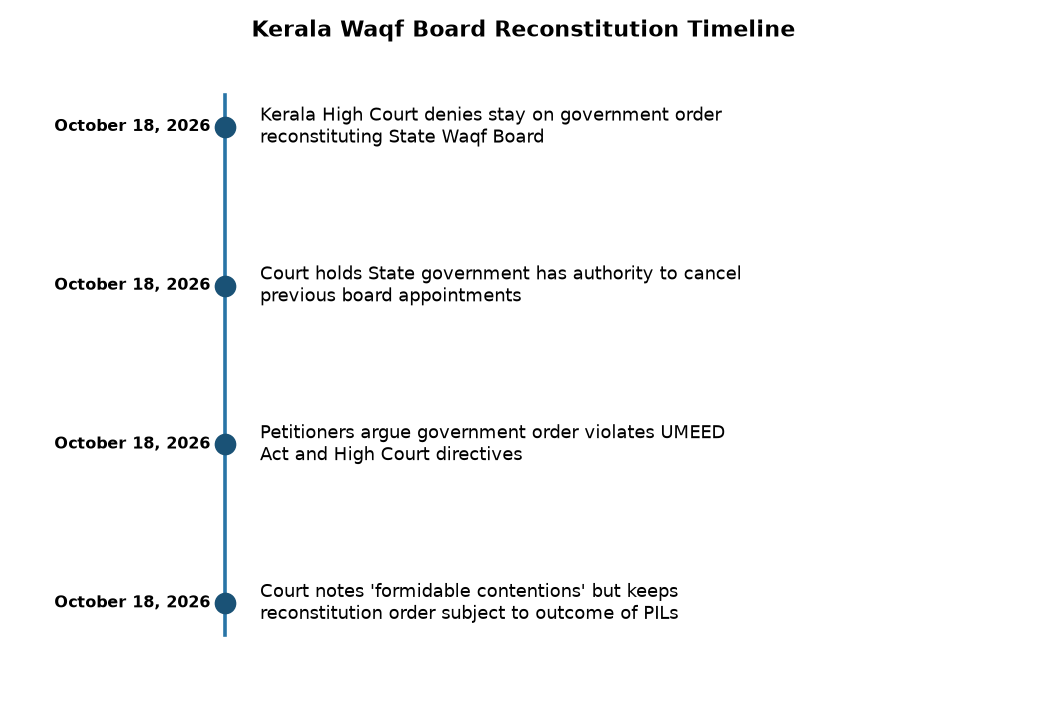
State government issues reconstitution order for Waqf Board → Former chairperson and member challenge the order in High Court → High Court holds that State government has implied authority to cancel appointments → Division Bench finds prima facie non-compliance with UMEED Act, 2025 → High Court refuses to stay reconstitution but subjects it to judicial review → Pending PILs challenge the constitution of the previous board → Outcome depends on judicial scrutiny of statutory compliance and executive authority
Prelims Practice Questions
Q1. Consider the following statements regarding the Kerala State Waqf Board and the UMEED Act, 2025:
1. The UMEED Act, 2025, mandates that the State Waqf Board must be reconstituted only after specific conditions are met, including a show-cause notice to the existing board.
2. The Kerala High Court, in its recent order, held that the State government has the implied authority to cancel appointments made to the previous Waqf Board.
3. The UMEED Act, 2025, is a central legislation applicable uniformly across all states in India.
How many of the above statements are correct?
- Only one
- Only two
- All three
- None
Answer: Only two — Statement 1 is correct as the UMEED Act, 2025, outlines specific procedural conditions for reconstitution of the Waqf Board. Statement 2 is correct as per the Kerala High Court’s observation in the recent order. Statement 3 is incorrect as the UMEED Act is a state-specific legislation applicable in Kerala.
Q2. Assertion (A): The Kerala High Court, in its recent order, refused to stay the reconstitution of the Kerala State Waqf Board by the State government.
Reason (R): The court held that the State government possessed the implied authority to cancel appointments made to the previous board, subject to the outcome of pending PILs.
In the context of the above assertion and reason, which of the following is correct?
- Both A and R are true, and R is the correct explanation of A.
- Both A and R are true, but R is not the correct explanation of A.
- A is true, but R is false.
- A is false, but R is true.
Answer: Both A and R are true, and R is the correct explanation of A. — Assertion (A) is true as the court refused to stay the reconstitution. Reason (R) is also true and correctly explains the assertion, as the court’s reasoning relied on the State government’s implied authority to cancel appointments.
Q3. Match the following provisions with their respective legal frameworks:
Column I (Provision) | Column II (Legal Framework)
1. Reconstitution of State Waqf Board | A. Waqf Act, 1995
2. Implied authority of State government to cancel appointments | B. UMEED Act, 2025
3. Judicial review of administrative orders | C. Constitution of India, Article 226
4. Vesting of waqf properties | D. Transfer of Property Act, 1882
Select the correct match:
- 1-B, 2-A, 3-C, 4-D
- 1-B, 2-C, 3-A, 4-D
- 1-A, 2-B, 3-C, 4-D
- 1-C, 2-A, 3-B, 4-D
Answer: 1-B, 2-A, 3-C, 4-D — 1-B: The UMEED Act, 2025, governs the reconstitution of the State Waqf Board. 2-A: The implied authority to cancel appointments stems from the Waqf Act, 1995. 3-C: Judicial review of administrative orders is governed by Article 226 of the Constitution. 4-D: Vesting of waqf properties is addressed under the Transfer of Property Act, 1882.
Mains Practice Question
✍ The Kerala High Court’s refusal to stay the State government’s reconstitution of the Kerala State Waqf Board raises critical questions about the balance between executive authority and judicial review in matters of religious and charitable institutions. Critically examine the constitutional and legal framework governing the reconstitution of State Waqf Boards, with particular reference to the UMEED Act, 2025, and the Waqf Act, 1995. Also, analyse the judicial principles that govern the exercise of executive power in superseding statutory bodies. (15 Marks)
Approach: MODEL-ANSWER SKELETON:
1. **Introduction (2 marks)**: Define the Kerala State Waqf Board and its constitutional/legal basis under the Waqf Act, 1995. Briefly introduce the UMEED Act, 2025, as a state-specific legislation aimed at reforming waqf administration.
2. **Legal Framework Governing Waqf Boards (4 marks)**:
– Waqf Act, 1995: Provisions on constitution, powers, and functions of State Waqf Boards (Sections 9-12).
– UMEED Act, 2025: Key provisions on reconstitution, conditions precedent (e.g., show-cause notice, prima facie findings of irregularities), and timelines.
– Role of the State government vs. statutory autonomy of the Waqf Board.
3. **Executive Authority and Judicial Review (5 marks)**:
– Doctrine of separation of powers: Executive’s implied authority to cancel appointments (as observed by the Kerala High Court) vs. statutory safeguards.
– Judicial principles:
– *State of Bihar v. Bal Mukund Sah* (2000): Judicial restraint in matters of executive discretion.
– *Union of India v. R. Gandhi* (2010): Judicial review of administrative actions affecting statutory bodies.
– Balance between *executive supremacy* and *judicial oversight*: When can the court intervene?
4. **Recent Judicial Trends and Controversies (3 marks)**:
– Kerala High Court’s observations: Implied authority of the State government vs. pending PILs challenging the constitutionality of the UMEED Act.
– Public Interest Litigation (PIL) as a tool for judicial activism in governance of religious institutions.
5. **Conclusion (1 mark)**: Synthesis of arguments—need for clarity in legislative intent, judicial caution in interfering with executive actions, and the role of PILs in ensuring accountability.
Source: The Hindu
Kerala PCS (Kerala PSC (KAS)) — State PCS Practice
Prelims: Which of the following statements is correct regarding the recent Kerala High Court order on the reconstitution of the State Waqf Board?
- The Kerala High Court granted a stay on the government’s order reconstituting the State Waqf Board.
- The Kerala High Court denied a stay on the government’s order reconstituting the State Waqf Board.
- The Kerala High Court directed the government to dissolve the State Waqf Board immediately.
- The Kerala High Court upheld the State Waqf Board’s decision to reject the government’s reconstitution order.
Answer: The Kerala High Court denied a stay on the government’s order reconstituting the State Waqf Board. — The Kerala High Court denied a stay on the government’s order reconstituting the State Waqf Board, allowing the government’s decision to proceed.
Mains: Critically examine the significance of the Kerala High Court’s decision to deny a stay on the reconstitution of the State Waqf Board. Discuss its implications on the administrative autonomy of the Waqf Board and the role of the judiciary in such matters.
Generated by AanyaAi for educational purpose.
Related guides on our sites
- Anthropology VS PSIR
- Best PSIR optional coaching
- Best PSIR optional coaching online
- Best PSIR optional teacher

- विशाखापट्टनम में उच्च जोखिम गर्भावस्था की निगरानी बढ़ाने पर कलेक्टर का निर्देश, जानिए पूरी जानकारी - October 21, 2026
- National Unity Day 2026: Key Preparations & Significance for UPSC - October 21, 2026
- 14वां इंडिया केम 2026: मुंबई में वैश्विक रसायन उद्योग का महाकुंभ - October 21, 2026

No Comments