


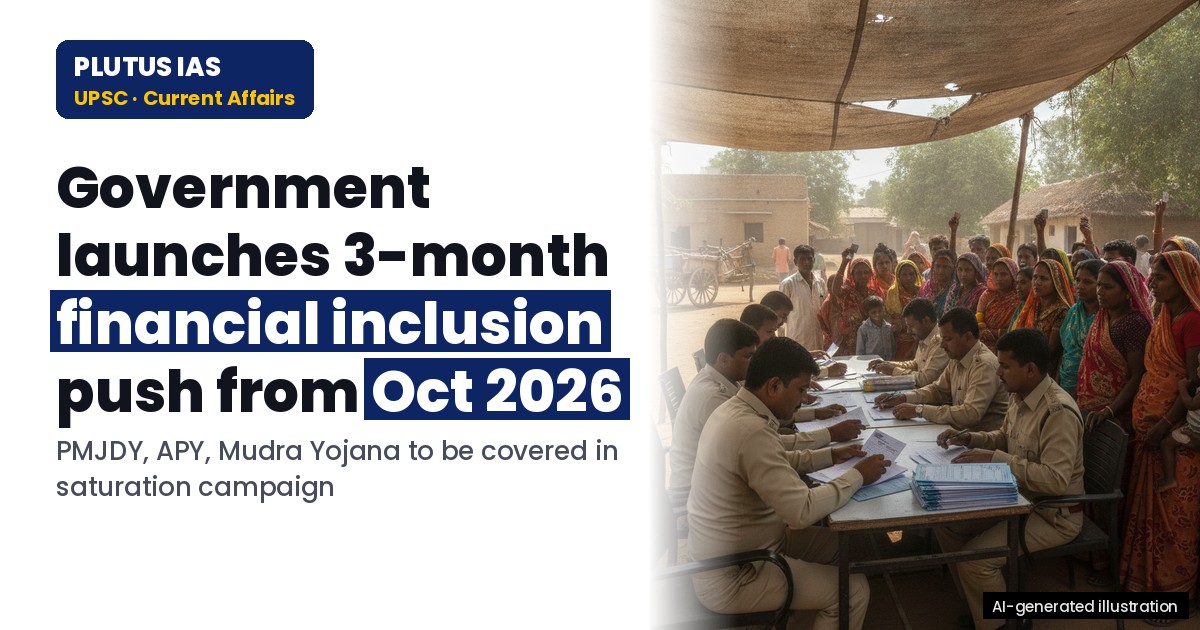
19 Oct Saturation Campaign: Financial Inclusion Schemes Launch Oct 2026
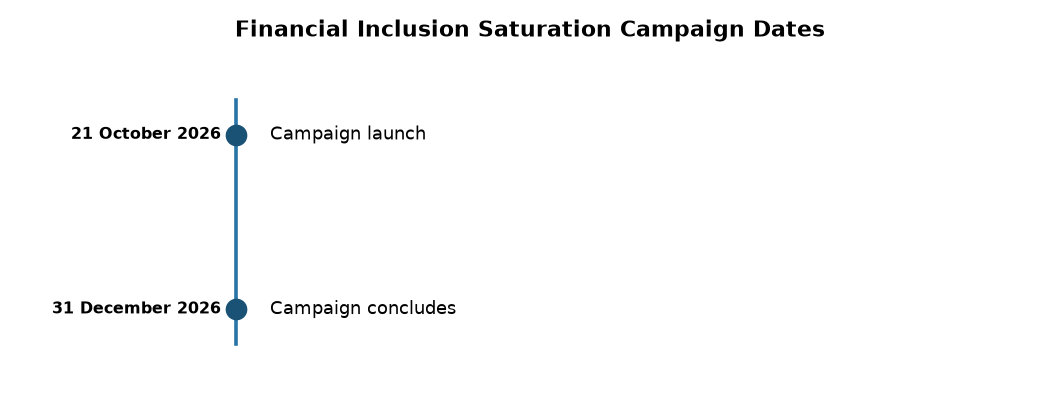
✎ The Saturation Campaign for Financial Inclusion (21 Oct–31 Dec 2026) aims to achieve universal access to banking, credit, insurance, and pension through PMJDY, leveraging the JAM Trinity, FI-Index, and digital public…
Subject Relevance — Where This Topic Fits
- GS Paper II — Governance, Welfare Schemes for Vulnerable Sections | GS Paper III — Indian Economy and Issues Relating to Planning, Mobilisation of Resources
- Prelims: Pradhan Mantri Jan Dhan Yojana (PMJDY), Direct Benefit Transfer (DBT), Financial Inclusion Index (FI-Index), RBI’s Financial Inclusion Plan (FIP), Jan Dhan-Aadhaar-Mobile (JAM) Trinity
- Essay: Financial inclusion as a catalyst for inclusive growth, Digital public infrastructure and its role in socio-economic transformation
Quick Revision: The Saturation Campaign for Financial Inclusion (21 Oct–31 Dec 2026) aims to achieve universal access to banking, credit, insurance, and pension through PMJDY, leveraging the JAM Trinity, FI-Index, and digital public infrastructure for last-mile delivery.
Why is this in the news?
The Government of India has announced a saturation campaign for financial inclusion schemes, scheduled from 21 October 2026 to 31 December 2026, aimed at achieving universal access to banking services, credit facilities, insurance, and pension products for all eligible citizens. This initiative underscores the sustained policy emphasis on reducing financial exclusion and leveraging digital public infrastructure to ensure last-mile delivery of financial services.
Background
- Financial inclusion has been a cornerstone of India’s development strategy since the late 1960s, evolving from the establishment of Regional Rural Banks (RRBs) to the landmark launch of the Pradhan Mantri Jan Dhan Yojana (PMJDY) in 2014.
- The PMJDY, a flagship scheme under the Department of Financial Services, Ministry of Finance, seeks to ensure access to financial services, namely, basic savings and deposit accounts, remittance, credit, insurance, and pension in an affordable manner.
- As of March 2024, over 51 crore Jan Dhan accounts have been opened, with a balance exceeding ₹2.3 lakh crore, reflecting significant progress in banking the unbanked population.
- The Reserve Bank of India (RBI) introduced the Financial Inclusion Index (FI-Index) in 2021 to measure the extent of financial inclusion across India, encompassing parameters such as access, usage, and quality of financial services.
- The Jan Dhan-Aadhaar-Mobile (JAM) Trinity has been instrumental in enabling Direct Benefit Transfers (DBT), reducing leakages, and ensuring targeted welfare delivery to beneficiaries.
- The saturation campaign aligns with the G20’s Financial Inclusion Action Plan and India’s commitment to achieving Sustainable Development Goal (SDG) 10, which emphasises reducing inequality through inclusive financial systems.
What is the Saturation Campaign of Financial Inclusion Schemes?
- The saturation campaign is a time-bound, mission-mode initiative to ensure that every eligible citizen in India has access to at least one basic financial product, including a savings account, debit card, insurance, and pension scheme.
- The campaign will leverage the existing infrastructure of banks, post offices, and digital payment systems, including the Unified Payments Interface (UPI) and Aadhaar Enabled Payment System (AEPS), to achieve universal coverage.
- Special focus will be placed on underserved regions, including aspirational districts, tribal areas, and remote rural regions, where financial exclusion persists due to infrastructural and socio-economic barriers.
- The campaign will utilise the Financial Inclusion Index (FI-Index) as a monitoring tool to assess progress and identify gaps in coverage, usage, and quality of financial services.
- Awareness drives, door-to-door campaigns, and community mobilisation will be conducted to ensure that citizens are informed about the benefits of financial inclusion and the process of availing these services.
- Banks and financial institutions will be incentivised to open accounts in unbanked areas and to ensure that existing accounts are active and functional, with zero balance requirements waived for a specified period.
- The campaign will also emphasise the promotion of digital financial literacy, particularly among women, senior citizens, and marginalised communities, to enable them to utilise digital banking services effectively.
Key Features
| Feature | Significance |
|---|---|
| Saturation Campaign Duration | A concentrated 72-day period (21 Oct–31 Dec 2026) for intensified financial inclusion outreach, leveraging existing schemes to achieve near-universal coverage. |
| Multi-Stakeholder Coordination | Involves central ministries, state governments, banks, NBFCs, and fintech entities to ensure seamless service delivery and reduce last-mile gaps. |
| Digital-First Approach | Prioritises digital onboarding, e-KYC, and mobile-based financial services to enhance accessibility and reduce transaction costs for underserved populations. |
| Grievance Redressal Mechanism | Strengthens real-time monitoring via dedicated helplines and district-level committees to address bottlenecks in account opening or service delivery. |
| Outcome Metrics | Targets measurable indicators such as percentage of unbanked households, digital transaction volumes, and penetration of insurance/pension products in rural and tribal districts. |
Why it Matters
Economic Inclusion
- Expands formal financial access to marginalised groups, thereby integrating them into the digital economy and reducing dependency on informal credit mechanisms.
- Enhances savings culture, fosters investment in micro-enterprises, and supports government welfare transfers through direct benefit transfers (DBT).
- Strengthens the formal credit ecosystem by increasing the customer base for banks and financial institutions, particularly in aspirational districts.
Social Equity
- Bridges the gender and regional divide by prioritising women, SC/ST communities, and remote geographies in outreach programmes.
- Reduces financial exclusion risks for migrant workers, small farmers, and daily wage labourers through simplified account-opening processes.
- Supports socio-economic mobility by linking financial inclusion to skill development and entrepreneurship schemes.
Governance Efficiency
- Demonstrates the efficacy of a time-bound, mission-mode approach in achieving public policy objectives, akin to past campaigns like the Swachh Bharat Mission.
- Facilitates real-time data analytics to identify and address systemic gaps in service delivery across districts.
- Promotes inter-ministerial convergence, reducing duplication of efforts and optimising resource utilisation.
Technological Advancement
- Accelerates the adoption of fintech solutions, including blockchain for KYC and AI-driven credit scoring for underserved segments.
- Encourages the development of low-cost, user-friendly digital payment infrastructure in rural and semi-urban areas.
- Enhances cybersecurity frameworks to safeguard financial transactions and customer data in a rapidly digitising ecosystem.
Challenges
1. Digital Divide and Infrastructure Gaps
- Limited internet penetration and smartphone access in remote tribal and hilly regions hinder seamless onboarding.
- Inadequate last-mile connectivity in rural areas exacerbates delays in service delivery and grievance redressal.
UPSC Link: GS-III: Digital Infrastructure
2. Financial Literacy and Trust Deficit
- Low awareness among marginalised communities about the benefits of formal financial services and digital transactions.
- Distrust in banks and government schemes due to past experiences of exclusion or mis-selling of financial products.
UPSC Link: GS-II: Welfare Schemes
3. Regulatory and Compliance Burdens
- Stringent KYC norms, though necessary, create barriers for low-income individuals lacking formal identity documents.
- Multi-layered compliance requirements for fintech and banking partners increase operational costs and slow down scaling efforts.
UPSC Link: GS-III: Financial Sector Reforms
4. Sustainability of Outreach Efforts
- Risk of campaign fatigue post-2026, leading to a decline in momentum without sustained policy and institutional support.
- Dependence on temporary staff and volunteers for ground-level implementation may compromise quality and accountability.
UPSC Link: GS-II: Governance
5. Data Privacy and Cybersecurity Risks
- Increased digital transactions elevate exposure to fraud, identity theft, and data breaches, particularly for vulnerable populations.
- Lack of robust cybersecurity frameworks in rural and semi-urban financial service providers.
UPSC Link: GS-III: Cyber Security
6. Coordination Among Stakeholders
- Fragmented implementation across states due to varying administrative capacities and resource allocations.
- Misalignment between central schemes and state-level priorities may lead to suboptimal outcomes.
UPSC Link: GS-II: Centre-State Relations
Challenges — UPSC Perspective
| Issue | Concern |
|---|---|
| Digital Infrastructure | Inadequate internet and power supply in rural areas delays account opening and transaction processing. |
| Financial Literacy | Low awareness among women and elderly populations about digital banking and insurance products. |
| Identity Verification | Challenges in Aadhaar seeding and biometric authentication for manual labourers and elderly citizens. |
| Fraud Prevention | Rise in phishing scams targeting new account holders due to lack of awareness and weak grievance redressal. |
| Resource Allocation | Uneven distribution of funds and personnel across districts leads to disparities in campaign effectiveness. |
| Monitoring and Evaluation | Real-time data gaps hinder accurate tracking of progress and adaptive policy adjustments. |
Government Initiatives — Must-Memorise for Prelims
- Pradhan Mantri Jan Dhan Yojana (PMJDY)
- Stand-Up India Scheme
- Pradhan Mantri Suraksha Bima Yojana (PMSBY)
- Pradhan Mantri Jeevan Jyoti Bima Yojana (PMJJBY)
- Atal Pension Yojana (APY)
- Direct Benefit Transfer (DBT) Scheme
Way Forward
- Constitute state-level task forces with district collectors as nodal officers to oversee campaign implementation and grievance redressal.
- Leverage Common Service Centres (CSCs) and post offices as last-mile service delivery points for account opening and financial literacy workshops.
- Integrate Aadhaar-enabled Payment System (AePS) with local kirana stores and self-help groups to enhance accessibility in remote areas.
- Launch a national financial literacy campaign in regional languages, targeting women, SC/ST communities, and migrant workers.
- Develop a real-time dashboard for monitoring key metrics, including account openings, transaction volumes, and grievance resolution rates.
- Strengthen cybersecurity protocols by mandating multi-factor authentication and fraud detection systems for all digital transactions.
- Establish a dedicated helpline with multilingual support and AI-driven chatbots to address queries and escalate grievances.
- Conduct post-campaign audits to assess impact and identify systemic gaps for long-term policy refinements.
UPSC Value Addition
Keywords for Mains Answer-Writing
Financial Inclusion · Jan Dhan Yojana · Pradhan Mantri Jan Dhan Yojana · Direct Benefit Transfer · Digital Payments · Financial Literacy · Banking Correspondents · Saturation Campaign · RBI Guidelines on Financial Inclusion · PMJDY Targets · Financial Services for Marginalised Groups · Digital India · Aadhaar Enabled Payment System · Microfinance Institutions · Self-Help Groups
Constitutional & Policy Linkages
- Article 38: Directive Principles of State Policy (Promotion of welfare of the people)
- Article 39: Directive Principles of State Policy (Equal pay for equal work and ownership of resources)
- Article 46: Directive Principles of State Policy (Promotion of educational and economic interests of SCs, STs and weaker sections)
Concept Flow
Policy Imperative → Financial Inclusion as a tool for socio-economic equity and economic growth → Campaign Design → Time-bound saturation approach with multi-stakeholder coordination and digital-first strategy → Implementation → Ground-level execution via banks, fintechs, and government agencies with real-time monitoring → Outcome → Increased formal financial access, reduced informality, and enhanced welfare delivery → Feedback Loop → Data-driven adjustments to address gaps and sustain momentum post-campaign → Long-Term Impact → Strengthened formal credit ecosystem, reduced poverty, and improved governance efficiency
Prelims Practice Questions
Q1. Consider the following statements regarding the Pradhan Mantri Jan Dhan Yojana (PMJDY):
1. PMJDY was launched in 2014 with the objective of providing universal access to banking facilities.
2. Under PMJDY, an overdraft facility of up to ₹10,000 is available to account holders after six months of satisfactory operation.
3. The scheme mandates the opening of a savings account with zero balance for all eligible individuals.
4. PMJDY accounts are eligible for the Direct Benefit Transfer (DBT) scheme without requiring Aadhaar seeding.
How many of the above statements are correct?
- Only one
- Only two
- Only three
- All four
Answer: Only three — Statements 1 and 2 are correct. Statement 3 is incorrect as the scheme does not mandate zero balance; accounts can be opened with zero balance but are not required to maintain it. Statement 4 is incorrect as Aadhaar seeding is required for DBT eligibility under PMJDY.
Q2. Assertion (A): The Reserve Bank of India (RBI) has issued guidelines to banks to ensure the inclusion of marginalised sections in the formal banking system.
Reason (R): Financial inclusion is a statutory obligation under the Banking Regulation Act, 1949, mandating banks to open branches in unbanked areas.
Options:
A. Both A and R are true, and R is the correct explanation of A.
B. Both A and R are true, but R is not the correct explanation of A.
C. A is true, but R is false.
D. A is false, but R is true.
Answer: ? — Assertion (A) is true as RBI guidelines do promote financial inclusion. Reason (R) is false because financial inclusion is not a statutory obligation under the Banking Regulation Act, 1949; it is a policy objective supported by RBI directives and schemes like PMJDY.
Mains Practice Question
✍ Critically examine the role of saturation campaigns in achieving universal financial inclusion in India. How far do such campaigns address the structural challenges in financial access, particularly for marginalised communities? (15 Marks)
Approach: MODEL-ANSWER SKELETON:
1. Define financial inclusion and its significance (RBI definition, Sustainable Development Goal 1.4).
2. Outline the structure of saturation campaigns: timeline (21 Oct–31 Dec 2026), target groups (unbanked households, women, SC/ST, migrant workers), and key components (account opening, Aadhaar seeding, DBT seeding, financial literacy, grievance redressal).
3. Link to PMJDY Phase IV (2022–2025) targets and RBI’s ‘Har Payment Digital’ mission.
4. Structural challenges: last-mile connectivity (geographical barriers, digital divide), trust deficit in formal banking, documentation gaps (Aadhaar-PAN mismatch), and gender disparities.
5. Role of saturation campaigns:
– Mass mobilisation via SHGs, ASHAs, and local leaders.
– Use of Banking Correspondents (BCs) and Common Service Centres (CSCs).
– Integration with Aadhaar Enabled Payment System (AEPS) and UPI.
6. Limitations: Sustainability post-campaign, data privacy concerns (Aadhaar), and post-campaign account dormancy.
7. Comparative perspective: Lessons from India’s ‘No Frills Accounts’ (2005) and Bangladesh’s ‘Mobile Financial Services’ model.
8. Conclude with a balanced view: saturation campaigns are necessary but insufficient without structural reforms in digital infrastructure, grievance redressal, and financial literacy.
Source: PIB (Press Information Bureau)
Generated by AanyaAi for educational purpose.
Related guides on our sites
- Anthropology VS PSIR
- Best PSIR optional coaching
- Best PSIR optional coaching online
- Best PSIR optional teacher

- स्ट्रेट ऑफ होर्मुज में भारतीयों से भरे तेल टैंकर पर प्रक्षेपास्त्र हमला, चालक दल सुरक्षित - October 22, 2026
- Rajya Sabha Bypoll on November 12: Key Dates & Process Explained - October 22, 2026
- सिम्बेक्स-2026: भारत-सिंगापुर नौसैनिक अभ्यास विशाखापत्तनम में शुरू, जानिए महत्वपूर्ण बिंदु - October 22, 2026

No Comments