


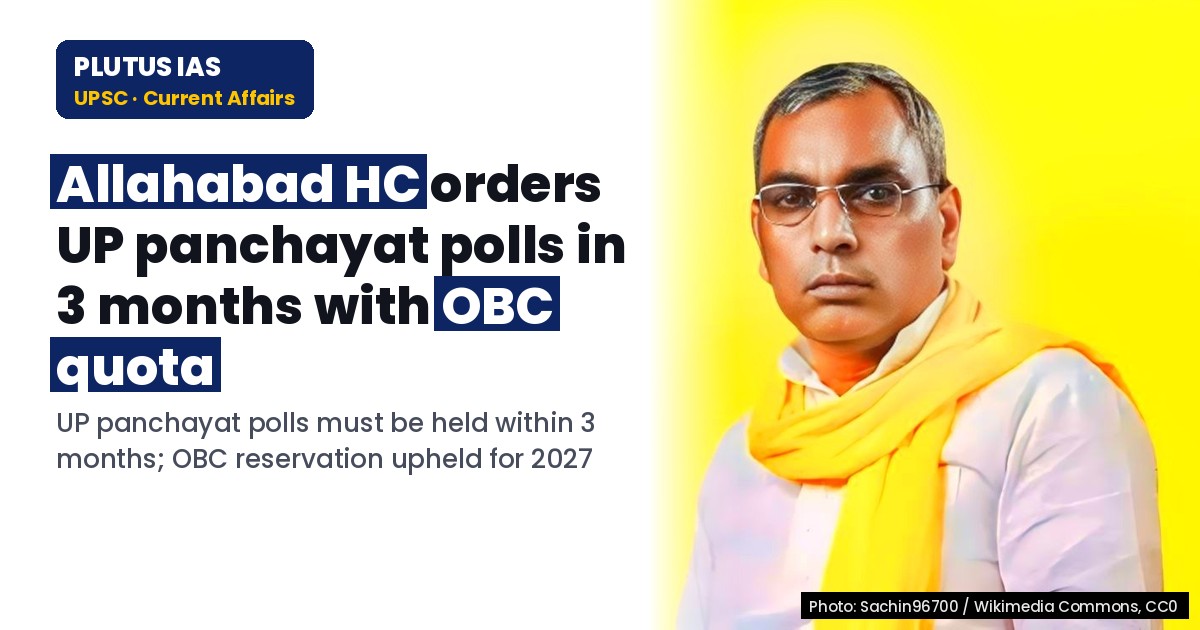
17 Oct UP Panchayat Polls: OBC Quota and 3-Month Deadline Explained
✎ The 'triple test' for OBC reservation in local bodies, as laid down by the Supreme Court, requires states to establish a dedicated commission, conduct empirical surveys on backwardness, and determine reservation proportions in…
Subject Relevance — Where This Topic Fits
- GS Paper II — Constitutional and Non-Constitutional Bodies (State Election Commission, Panchayati Raj Institutions) | GS Paper II — Fundamental Rights and Directive Principles of State Policy (Reservation in Local Bodies) | GS Paper III — Decentralisation and Local Governance (73rd Amendment Act, 1992)
- Prelims: Panchayati Raj System, 73rd Constitutional Amendment Act, OBC Reservation in Local Bodies, State Election Commission (SEC), Triple Test for OBC Reservation, Allahabad High Court, Reservation Framework for SCs, STs, and Women
- Essay: Role of Local Governance in Strengthening Democracy: A Case Study of Panchayati Raj in Uttar Pradesh, Balancing Social Justice and Governance: The Imperative of Reservation Policies in India
Quick Revision: The ‘triple test’ for OBC reservation in local bodies, as laid down by the Supreme Court, requires states to establish a dedicated commission, conduct empirical surveys on backwardness, and determine reservation proportions in compliance with constitutional limits.
Why is this in the news?
The Allahabad High Court has directed the Uttar Pradesh government to conduct panchayat elections within three months, adhering to the existing reservation framework, including the 27% quota for Other Backward Classes (OBCs). This directive assumes significance as it intersects with the ongoing inquiry by a dedicated commission into revised OBC reservation norms for local bodies, which must comply with the Supreme Court’s ‘triple test’ criteria. The decision underscores the constitutional obligations of states in ensuring inclusive and timely local governance while balancing electoral logistics and legal mandates.
Background
- The 73rd Constitutional Amendment Act, 1992, mandated the establishment of a three-tier Panchayati Raj system in India, devolving powers to local self-governments for democratic decentralisation.
- Uttar Pradesh, with over 12.58 crore voters, conducts panchayat elections under the supervision of the State Election Commission (SEC), an autonomous constitutional body.
- The Supreme Court, in *B.R. Ambedkar University v. Union of India* (2021), laid down the ‘triple test’ for OBC reservation in local body elections: (i) establishment of a dedicated commission, (ii) empirical inquiry into backwardness, and (iii) determination of reservation proportion in accordance with constitutional requirements.
- The tenure of elected panchayat bodies in Uttar Pradesh expired in May 2026, necessitating the conduct of fresh elections to uphold democratic continuity.
- The Uttar Pradesh State Rural Local Bodies Dedicated Backward Classes Commission was constituted on May 18, 2026, to examine OBC reservation in panchayati raj institutions, with a six-month mandate to submit recommendations.
- The Allahabad High Court’s directive of October 14, 2026, mandates the completion of panchayat polls within three months, aligning with the constitutional framework and existing reservation policies.
What is the Constitutional and Legal Framework Governing OBC Reservation in Panchayati Raj Institutions?
- The 73rd Amendment Act, 1992, inserted Part IX to the Constitution, establishing Panchayati Raj Institutions (PRIs) as institutions of self-government for rural areas, with provisions for reservation of seats for Scheduled Castes (SCs), Scheduled Tribes (STs), and women.
- Article 243D of the Constitution mandates reservation for SCs and STs in proportion to their population in local bodies, and not less than one-third of the total seats for women, including those reserved for SCs and STs.
- The Supreme Court, in *B.R. Ambedkar University v. Union of India* (2021), introduced the ‘triple test’ for OBC reservation in local body elections, requiring states to: (i) constitute a dedicated commission to identify OBCs in local bodies, (ii) conduct empirical surveys to assess backwardness, and (iii) determine reservation proportions based on quantifiable data.
- The State Election Commission (SEC) is a constitutional body under Article 243K, responsible for the superintendence, direction, and control of the preparation of electoral rolls and the conduct of elections to PRIs.
- The Uttar Pradesh State Rural Local Bodies Dedicated Backward Classes Commission was established to comply with the triple test, with its findings to be used for determining OBC reservation in panchayat elections.
- Reservations for OBCs in PRIs are subject to the ceiling of 50% total reservation, as per the Supreme Court’s judgment in *Indra Sawhney v. Union of India* (1992), which applies to local body elections as well.
- The Allahabad High Court’s directive ensures that elections are conducted under the existing reservation framework, including the 27% OBC quota, pending the commission’s recommendations and subsequent legal implementation.
- The SEC, in collaboration with the state government, must ensure that electoral logistics, including voter lists, ballot papers, and security arrangements, are in place to meet the court-mandated timeline.
Key Features
| Feature | Significance |
|---|---|
| Allahabad High Court Directive | Mandates completion of panchayat polls within three months, ensuring adherence to constitutional timelines and reservation frameworks. |
| 27% OBC Reservation Framework | Preserves existing reservation for Other Backward Classes in panchayat elections, pending empirical inquiry by a dedicated commission. |
| State Election Commission (SEC) Role | Responsible for executing the electoral process, including voter list preparation, polling arrangements, and deployment of manpower. |
| UP State Rural Local Bodies Dedicated Backward Classes Commission | Conducts empirical inquiry into OBC backwardness in local bodies to determine reservation proportions, as per Supreme Court’s triple test. |
| Constitutional Reservation Continuity | Ensures continuity of SC, ST, and women reservations in panchayat elections under applicable laws, even as OBC reservation is under review. |
Why it Matters
Constitutional and Legal
- The directive underscores the judiciary’s role in enforcing constitutional timelines for local body elections, particularly in ensuring timely completion of democratic processes.
- The Supreme Court’s triple test for OBC reservation in local bodies reinforces the principle of evidence-based reservation policies, balancing social justice with constitutional mandates.
- The preservation of existing reservations for SCs, STs, and women ensures continuity in representation, aligning with Articles 243D and 243T of the Constitution.
Administrative and Governance
- The panchayat polls serve as a critical governance mechanism for rural development, with elected representatives playing a pivotal role in local planning and implementation.
- The SEC’s preparation for elections, including voter list updates and manpower deployment, highlights the administrative challenges in conducting large-scale electoral exercises.
- The inquiry by the dedicated commission on OBC reservation reflects the state’s commitment to evidence-based policymaking in local governance.
Political and Electoral
- The completion of panchayat polls within a stipulated timeframe ensures that local democratic institutions are functional ahead of larger electoral cycles, such as the 2027 Assembly polls.
- The OBC reservation inquiry may influence future electoral strategies and political mobilisation in rural areas, given the significant demographic weight of OBC communities.
- The judiciary’s intervention in electoral timelines underscores the importance of judicial oversight in maintaining the integrity of democratic processes.
Challenges
1. Logistical Constraints in Electoral Management
- Conducting panchayat polls within three months requires rapid mobilisation of additional manpower, including police personnel, which may conflict with preparations for the 2027 Assembly elections.
- The SEC must coordinate with multiple departments to ensure voter list accuracy, polling station arrangements, and security deployment, all within a compressed timeline.
- The need for legal clarity on the reservation framework, particularly regarding OBC seats, adds complexity to the electoral process.
UPSC Link: GS-II: Constitutional and Statutory Bodies
2. Empirical Validation of OBC Reservation
- The dedicated commission must complete its inquiry within a stipulated timeframe to avoid further delays in the electoral process.
- Balancing the need for evidence-based reservation with the urgency of completing elections poses a significant challenge for policymakers.
- The commission’s recommendations may require legislative or administrative adjustments, which could introduce additional procedural delays.
UPSC Link: GS-II: Constitutional Provisions for SCs/STs/OBCs
3. Judicial Oversight and Compliance
- The Allahabad High Court’s directive imposes a strict timeline, requiring the state government and SEC to act swiftly to avoid contempt of court proceedings.
- Ensuring compliance with the court’s order while addressing logistical and legal challenges demands coordinated governance efforts.
- The judiciary’s role in enforcing constitutional timelines may set a precedent for future electoral disputes, particularly in local body elections.
UPSC Link: GS-II: Judiciary and Constitutional Governance
4. Socio-Political Dynamics in Reservation Policy
- The OBC reservation inquiry may face scrutiny from various stakeholders, including political parties, community groups, and civil society organisations.
- Balancing the demands of different social groups while adhering to constitutional principles requires careful negotiation and evidence-based policymaking.
- The outcome of the inquiry could influence future reservation policies in local bodies, with potential implications for electoral politics.
UPSC Link: GS-II: Reservation Policies and Social Justice
Challenges — UPSC Perspective
| Issue | Concern |
|---|---|
| Timeline Compliance | Ensuring panchayat polls are completed within three months while addressing logistical and legal challenges. |
| Reservation Framework Clarity | Maintaining continuity in OBC reservation while the dedicated commission conducts its inquiry. |
| Manpower Mobilisation | Deploying additional police and administrative personnel for election duty amid competing electoral priorities. |
| Legal Opinion and Compliance | Obtaining and implementing legal opinions on the High Court’s directive to avoid procedural lapses. |
| Empirical Inquiry Timeliness | Completing the OBC reservation inquiry within the stipulated timeframe to avoid further delays. |
| Voter List Accuracy | Ensuring voter rolls are updated and accurate ahead of the polls, despite administrative constraints. |
Way Forward
- The State Election Commission (SEC) must finalise the election programme in consultation with the state government, ensuring all preparatory steps are completed within the three-month deadline.
- The UP State Rural Local Bodies Dedicated Backward Classes Commission should expedite its inquiry into OBC reservation, submitting its report to the state government for further action.
- The state government must examine the commission’s recommendations and take necessary legal and administrative steps to implement them, if approved.
- Additional manpower, including police personnel, should be mobilised for election duty, with coordination between the SEC, state administration, and law enforcement agencies.
- Voter list verification and polling station arrangements must be completed promptly, with special attention to remote and rural areas to ensure inclusivity.
- Legal opinions on the High Court’s directive should be obtained and implemented to avoid procedural delays or contempt of court issues.
- Public awareness campaigns should be conducted to inform voters about the poll process, timelines, and their rights, ensuring high voter participation.
- Post-poll arrangements, including the swearing-in of elected representatives and the handover of administrative responsibilities, should be planned in advance to ensure smooth governance transition.
UPSC Value Addition
Keywords for Mains Answer-Writing
Panchayati Raj System · OBC Reservation in Local Bodies · Allahabad High Court Judgment · Triple Test for OBC Reservation · State Election Commission · UP State Rural Local Bodies Dedicated Backward Classes Commission · Constitutional Provisions for Local Body Elections · Reservation Framework in Panchayat Polls · Empirical Inquiry for OBC Backwardness · Constitutional Validity of Reservation Policies
Constitutional & Policy Linkages
- Article 243D: Reservation of seats for SCs and STs in Panchayats.
- Article 243T: Reservation of seats for women in Panchayats.
- Article 14: Right to Equality and Equal Protection of Laws.
- Article 16: Equality of Opportunity in Public Employment.
- Seventh Schedule: Distribution of Legislative Powers between Union and States.
Concept Flow
Constitution of UP State Rural Local Bodies Dedicated Backward Classes Commission (May 18, 2026) → Supreme Court’s triple test for OBC reservation in local bodies → Inquiry into OBC backwardness in panchayat institutions → Submission of recommendations to state government. → Expiry of elected panchayat bodies’ term (May 2026) → Allahabad High Court directive (October 14, 2026) → Mandate to complete panchayat polls within three months → SEC and state government preparation. → Preservation of existing OBC reservation framework (27%) → Continuity of SC, ST, and women reservations → High Court order on reservation continuity → Electoral process initiation. → SEC’s logistical preparations (voter lists, polling stations, manpower) → High Court timeline enforcement → Completion of panchayat polls → Governance transition in rural local bodies. → State government’s examination of commission’s recommendations → Legal and administrative steps for implementation → Potential adjustments in reservation framework → Future electoral strategies.
Prelims Practice Questions
Q1. Consider the following statements regarding the reservation framework for Other Backward Classes (OBCs) in local body elections in India:
1. The Supreme Court has mandated a triple test for OBC reservation in local bodies, which includes the establishment of a dedicated commission.
2. The triple test requires states to conduct an empirical inquiry into the backwardness of OBCs in local bodies.
3. The proportion of OBC reservation must be determined in accordance with constitutional requirements.
4. The Allahabad High Court has directed that OBC-reserved seats cannot be treated as open seats pending the inquiry by the state commission.
How many of the above statements are correct?
- Only one
- Only two
- Only three
- All
Answer: All — Statements 1, 2, and 3 are correct as they align with the Supreme Court’s triple test for OBC reservation in local bodies. Statement 4 is also correct, as per the Allahabad High Court’s directive in the UP panchayat polls case.
Q2. Assertion (A): The Allahabad High Court has directed Uttar Pradesh to complete panchayat elections within three months under the existing reservation framework, including the 27% OBC quota.
Reason (R): The Supreme Court’s triple test for OBC reservation in local bodies requires states to establish a dedicated commission and conduct an empirical inquiry into backwardness among OBCs.
Options:
A. Both A and R are true, and R is the correct explanation of A.
B. Both A and R are true, but R is not the correct explanation of A.
C. A is true, but R is false.
D. A is false, but R is true.
Answer: ? — Assertion (A) is true as the Allahabad High Court has directed the completion of panchayat elections within three months under the existing reservation framework. Reason (R) is also true as it correctly states the Supreme Court’s triple test for OBC reservation. However, R does not directly explain A, as the High Court’s directive is based on the existing framework, not the triple test itself.
Mains Practice Question
✍ Critically examine the constitutional and judicial framework governing reservation for Other Backward Classes (OBCs) in local body elections in India. In your answer, elucidate the significance of the Supreme Court’s triple test and analyse its implications for the conduct of panchayat polls. Also, discuss the role of the State Election Commission and the State Commissions for Backward Classes in this context. (15 Marks)
Approach: MODEL-ANSWER SKELETON:
1. **Introduction (2 marks)**: Define the constitutional basis of reservation in local body elections (Articles 243D, 243T) and the need for affirmative action.
2. **Supreme Court’s Triple Test (5 marks)**:
– Explain the triple test as laid down in *Krishna Murthy v. Union of India* (2010) and *Ajit Prasad Jain v. State of Bihar* (2021).
– Highlight the three components: dedicated commission, empirical inquiry, and proportionate reservation.
– Discuss its rationale in ensuring social justice while preventing arbitrary reservations.
3. **Judicial Framework and Recent Judgments (4 marks)**:
– Reference the Allahabad High Court’s directive in the UP panchayat polls case (2026) and its implications.
– Explain the role of the State Election Commission (SEC) in conducting elections under the reservation framework.
4. **Role of State Commissions for Backward Classes (2 marks)**:
– Discuss the functions of the UP State Rural Local Bodies Dedicated Backward Classes Commission.
– Explain how its recommendations will shape future reservation policies.
5. **Critique and Challenges (2 marks)**:
– Highlight challenges such as empirical data limitations, delays in commission reports, and balancing social justice with electoral timelines.
6. **Conclusion (2 marks)**: Summarise the need for a balanced approach that upholds constitutional principles while ensuring timely conduct of elections.
Source: The Indian Express
Generated by AanyaAi for educational purpose.
Related guides on our sites
- Best PSIR optional test series
- Anthropology VS PSIR
- Best PSIR optional coaching
- Best PSIR optional coaching online

- विशाखापट्टनम में उच्च जोखिम गर्भावस्था की निगरानी बढ़ाने पर कलेक्टर का निर्देश, जानिए पूरी जानकारी - October 21, 2026
- National Unity Day 2026: Key Preparations & Significance for UPSC - October 21, 2026
- 14वां इंडिया केम 2026: मुंबई में वैश्विक रसायन उद्योग का महाकुंभ - October 21, 2026

No Comments